The call usually comes the morning after a southerly. There is a brown ring on the hallway ceiling, a bucket under it, and one question before anything else: how much is this going to cost me? It is a fair question, and we hear it on most leak jobs across Shellharbour.
The honest answer is that roof leak repair cost depends far more on why the roof is leaking than on the fact that it is leaking. Two homes on the same street can both have a drip in the lounge room. One needs a single cracked tile swapped. The other has a rusted valley that has been letting water in for years. Same symptom, very different bill.
This guide explains what actually sets the price, what a fair quote should tell you, and the few things you can do to keep the cost down. We have spent more than 10 years on tile and metal roofs around the Shellharbour region, and the patterns below are the ones we see over and over.
Finding the leak is often half the job
This one surprises people. The wet patch on your ceiling is rarely directly under the hole. Water gets in at one point, runs along a batten, a rafter or the sarking (the foil or membrane layer under the roofing), and drops onto the plasterboard somewhere else entirely. On a low-pitched roof it can travel a long way.
So part of what you pay for is the time spent tracing it. On a simple job that is a few minutes in the roof space with a torch. On a stubborn one it means lifting tiles, checking flashings and sometimes running water over sections of roof until the drip shows up inside. If you want to know what that process looks like, we have written up how we track down a hidden roof leak step by step.
A quote that skips this part is a guess. If someone prices a repair over the phone without looking, they are pricing the most likely cause, not your cause.
The cause sets the price, not the size of the stain
Once the source is found, the repair itself falls into one of a handful of categories. Roughly from smallest to largest, these are the ones we deal with most:
- Cracked or slipped tiles. Usually the simplest fix, as long as a matching tile can be found.
- Loose or rusted screws on a metal roof. The rubber washers perish and the screw heads rust, particularly close to the water. Replacing them across an affected run is quick work.
- Cracked ridge pointing. The flexible mortar holding the ridge caps in place breaks down with age. A short section can be patched, but if the whole ridge is tired, repointing it properly costs more and lasts far longer.
- Failed flashings. The metal strips sealing the roof against walls, chimneys, skylights and vents. These take more time because they often have to be removed, reshaped or replaced.
- Rusted valleys or box gutters. Valleys are the channels where two roof slopes meet. When the valley iron rusts through, the only proper fix is new iron, and that means lifting the tiles or sheets along both sides.
- Rusted roof sheets. Once a sheet has rusted through, it gets replaced. Patching over corroded steel only buys a short delay.
Ridge leaks are common enough on older tile roofs here that we wrote a separate piece on when a ridge needs repointing. It is worth a read if your leak is near the top of the roof.
Tile and metal roofs cost differently to fix
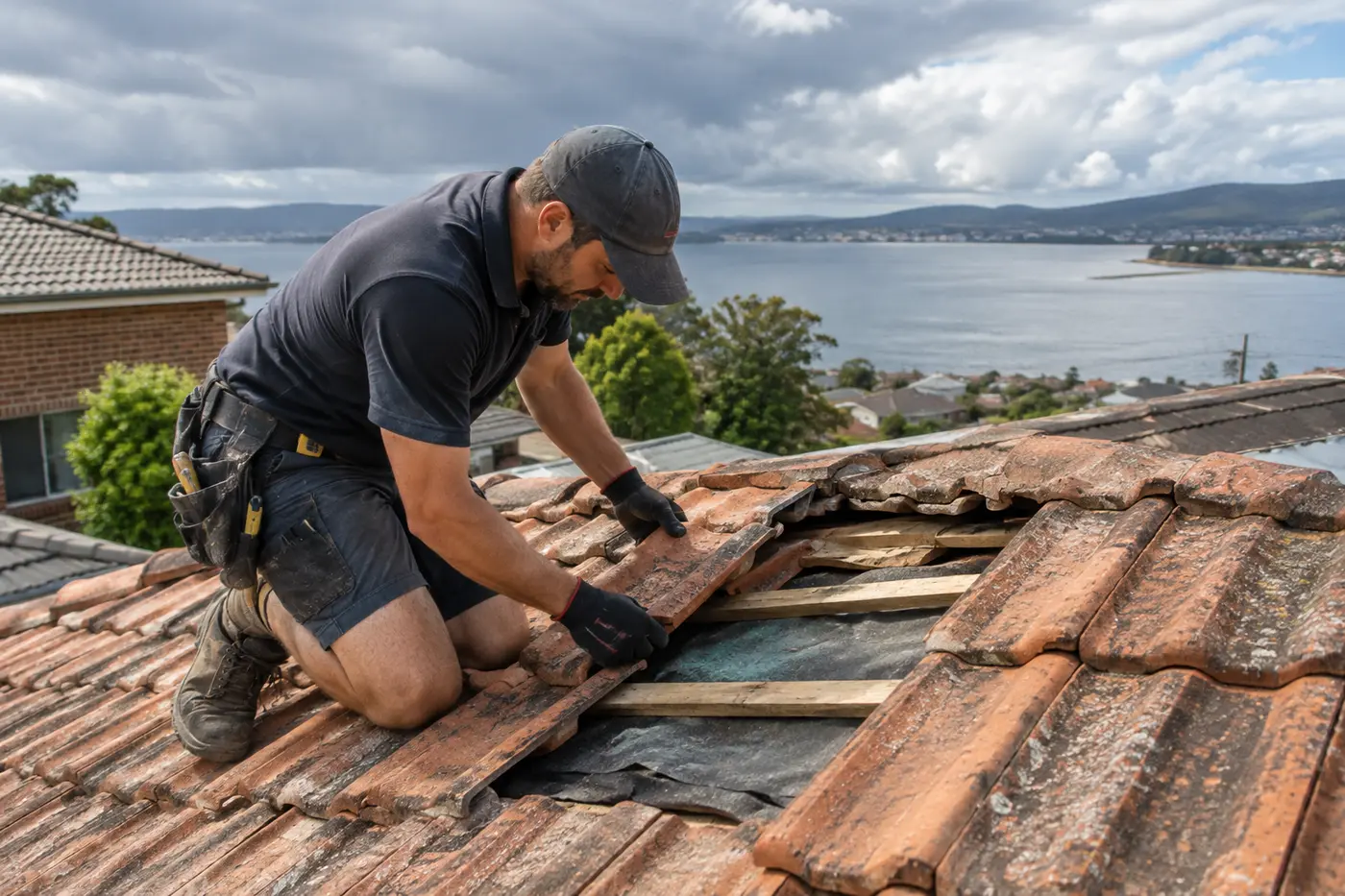
On a tile roof the big variable is the tile itself. Concrete and terracotta profiles have changed over the decades, and some older ones are no longer made. If we cannot source a match, we may have to borrow tiles from a less visible part of the roof and use a close match there. That takes extra time. Old terracotta can also be brittle, so simply walking on it carefully adds to the hours.
Metal roofs are usually quicker to get around on, but the problems tend to spread. Rust rarely stops at one screw. If one fastener has failed from salt exposure, the ones beside it are often not far behind, and a responsible repair deals with the whole affected run instead of the one you can see.
Living near the water changes the maths
Shellharbour, Shell Cove, Warilla and Barrack Heights all sit in the salt spray zone, and homes around Lake Illawarra deal with damp air most of the year. Salt speeds up corrosion on flashings, fixings and any exposed steel. In practice that means a leak repair on a coastal home more often turns up extra corrosion nearby that also needs attention.
We would rather tell you about that at the quote stage than leave it for the next storm to find. You can then decide whether to fix only the active leak now or deal with the surrounding wear at the same time. That is your call to make, with the facts in front of you.
Access, height and urgency add to the bill
A single-storey home with a gentle pitch is the cheapest kind of roof to work on. A steep two-storey roof is not. Safety rules require fall protection on higher and steeper roofs, so edge protection or scaffolding can become part of the job, and that cost exists whether the repair is large or small.
Urgency matters too. If water is coming in during a storm, the first visit is about stopping it: a tarp or temporary seal to protect the ceiling and wiring. The permanent fix happens once the roof is dry and safe to work on. That is two visits instead of one, and it is the right way to do it. Rushing a permanent repair on a wet roof is how tiles get broken and seals fail.
What a fair quote should tell you
We work on a decision-first approach: you get the facts about your roof and your options, not a sales pitch. Whoever you use, a written quote for a leak repair should answer these things plainly:
- What is causing the leak, and where it is
- Exactly what will be replaced or repaired
- Whether the fix is permanent or a temporary measure
- Any other problems spotted that are not included in the price
Be wary of a repair that is mostly silicone. A bead of sealant over a cracked tile or a rusted joint is cheap on the day and often fails within a season or two, which means paying again. Sealant has its place, but it is not a substitute for replacing the failed part.
If you would like a roofer to look at the source and give you a written price, our roof repair service covers tile and metal roofs across the region, from Albion Park to Shell Cove.
How to keep the cost of a leak repair down
The single biggest saving is acting early. A drip that is fixed in the first week usually involves one part of the roof. Left for a year, the same leak can rot battens, stain and sag plasterboard, and damage insulation, and the roof repair becomes only one line of a much bigger bill.
A few other things genuinely help:
- Note when it leaks. Only in heavy rain, only with wind from the south, or every time it rains? That narrows the search and cuts the tracing time.
- Take photos of the stain and any drips, with the date.
- Keep gutters and valleys clear of leaves. Overflowing gutters cause plenty of leaks that look like roof faults.
- Stay off a tile roof yourself. Every cracked tile from a well-meaning climb adds to the job.
And if the stain might not be the roof at all, check first. A leaking shower or pipe can look identical from below, and our guide to telling a roof leak from a plumbing leak may save you calling the wrong trade.
When repairing stops making sense
Most leaks are worth repairing. But if we are finding several leaks at once, rust across many sheets, or tiles crumbling as they are touched, patching one spot after another becomes the expensive option. At that point a restoration or a new roof can cost less over the next decade than a string of call-outs. We will tell you if we think you have reached that point, and explain why, so you can weigh it up properly.
If there is a stain spreading on your ceiling right now, get it looked at before the next rain. Ryan and the team can find the source, explain what is causing it and put a written price in front of you. Start with a free quote for leak repairs on your tile or metal roof.
Common questions about leak repair costs
How much does it cost to fix a roof leak?
It depends on the cause, the roof type and how hard the area is to reach. Replacing a cracked tile on a single-storey home is at the small end, while new valley iron on a steep two-storey roof is at the large end. A roofer needs to find the source before they can give you a reliable number.
Is it easy to fix a leaky roof?
The repair itself is often straightforward. The hard part is finding where the water actually gets in, because it can travel well away from the hole before it shows on the ceiling. Climbing up to fix it yourself also carries a real fall risk and often breaks more tiles than it fixes.
Does home insurance cover roof leaks?
Many policies cover sudden damage, such as a storm blowing tiles off, but exclude leaks caused by gradual wear, rust or lack of maintenance. Check your product disclosure statement and call your insurer early. A written report from the roofer stating the cause helps with any claim.
Should I get a temporary fix or a permanent repair?
If water is coming in during bad weather, a temporary fix to protect the ceiling and wiring is the right first step. Treat it as exactly that, though. Book the permanent repair once the roof is dry, because tarps and sealant are not designed to last.
Why did my roof only start leaking in heavy rain?
Heavy, wind-driven rain pushes water into gaps that light rain never reaches, such as under lifted flashings, through worn ridge pointing or over the edge of a blocked valley. It usually means a small weakness that has been there for a while, and it is cheaper to fix now than after the next big storm.
Is it worth repairing an old roof or should I replace it?
If the leaks are isolated and the rest of the roof is sound, repair is almost always the better value. If there are multiple leaks, widespread rust or brittle tiles, compare the repair quote against a restoration or replacement before you commit.