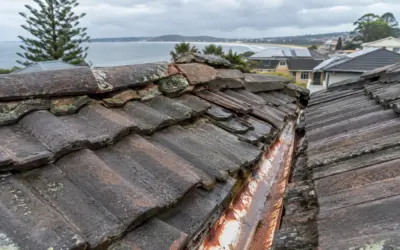
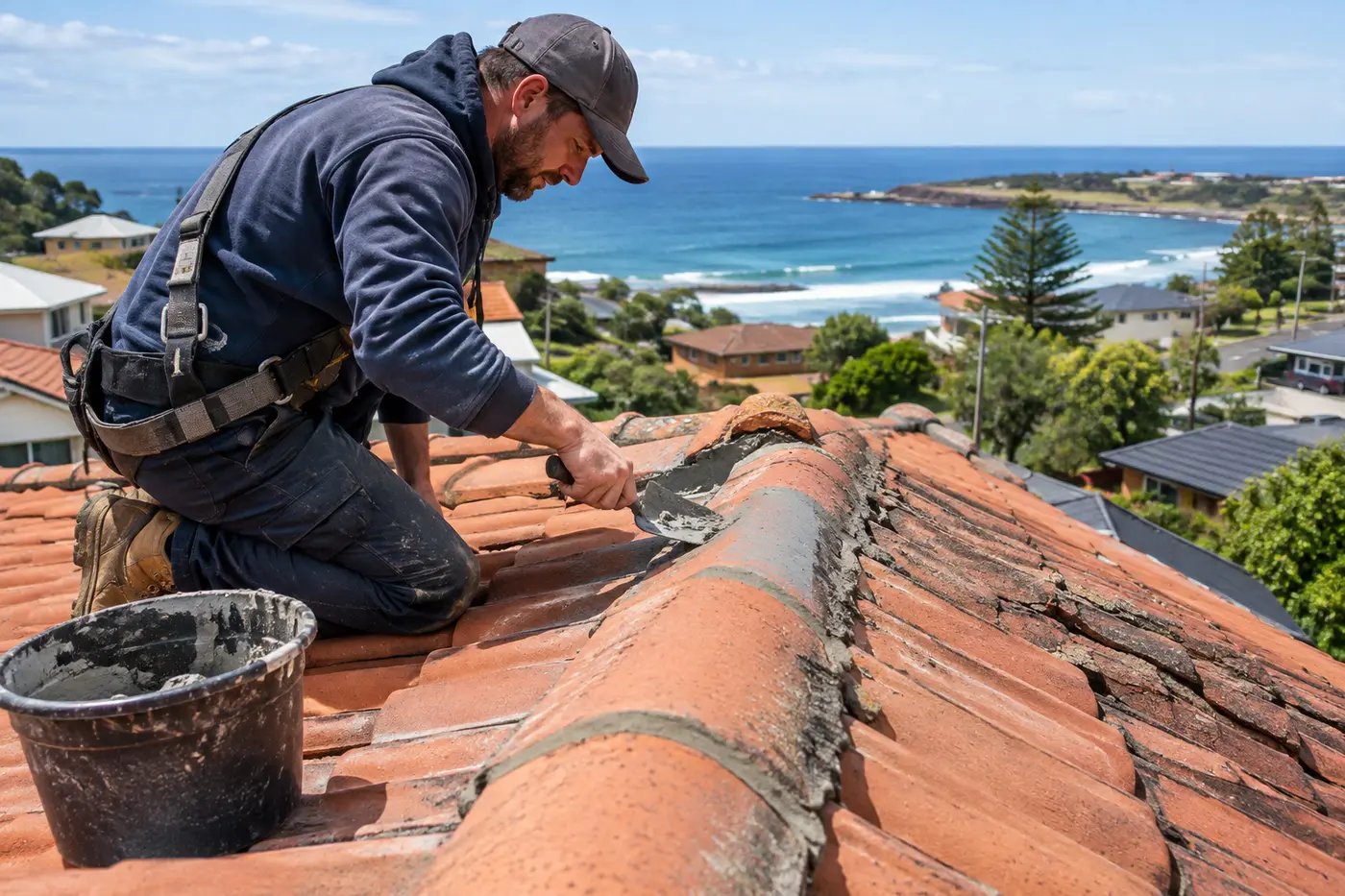
You are up a ladder clearing the gutters and there it is again: little chunks of grey or orange grit sitting in the gutter, more than leaves or dirt would explain. Look up along the ridge of a tile roof and you will often find where it came from. The mortar holding the ridge caps in place is cracking and washing off, a piece at a time. That is the point where most people start searching for roof repointing, and it is a good time to be asking the question, because this is a small job to fix early and a much bigger one to fix late.
Failed pointing is one of the most common things we find on tile roofs around Shellharbour. Here is what it is, how to spot it and what a proper job involves.
Your ridge caps sit on two layers of mortar, not one
Where two slopes of a tile roof meet, along the top (the ridge) and down the angled corners (the hips), the joint is covered by curved ridge caps. Unlike the rest of the tiles, those caps sit on mortar.
The first layer is the bedding: a sand and cement mix packed under each cap that seats it in place and fills the gap to the tiles below. The second layer is the pointing: a thin finishing coat over the bedding that seals it from the weather.
Older roofs were usually pointed with a cement mix too. Cement is rigid, and roofs are not. Tiles expand in the sun, contract at night and flex a little in wind, so rigid pointing slowly cracks. Modern pointing is a flexible compound that moves with the roof instead of fighting it. Repointing means stripping the tired old pointing and replacing it with the flexible kind.
Repointing and rebedding are two different jobs
Repointing only deals with the top layer. If the bedding underneath is still solid and the caps are sitting firm, we strip the loose pointing, clean the surface and apply new flexible pointing over the top. It is the lighter job.
Rebedding is needed when the bedding itself has cracked, shrunk or come loose. Then the caps have to be lifted off, the old mortar knocked out, fresh bedding laid and the caps reset in line before they are pointed again.
You cannot tell which one a roof needs from the ground. The test is physical: we press on the caps along the whole run. A cap that rocks or sounds hollow is sitting on failed bedding, and putting fresh pointing over it is like painting over rotten timber. It looks fine for a while, then it lets go. Most ridges we check are a mix, with some sections that only need pointing and a few that need rebedding, and a fair quote should say which is which.
Signs the pointing on your roof has had its day
- Cracks running along the pointing line, or pieces missing altogether
- Mortar grit collecting in gutters, valleys or on paths below the eaves
- Ridge caps that look out of line, lifted or slightly skewed
- Gaps where you can see bare bedding or the tile edge underneath
- Moss or lichen growing thickly in the joints
- Water stains on the ceiling that line up with a ridge or hip
That last one is the one people notice, but by then water has been getting in for a while. If you are already chasing a stain and are not sure where it is coming from, our guide on tracking down the cause of a roof leak covers the other usual suspects.
Coastal weather is hard on ridge mortar
Ridges and hips are the most exposed part of any roof, taking full sun and the full force of the wind. Here, that wind carries salt off the water and drives rain sideways when a southerly change comes through. Rain that falls straight down runs off a ridge. Rain pushed hard against it finds every crack, and the constant wetting, drying and salt all speed up how fast old cement mortar breaks down.
A roof in Shell Cove or Warilla that has been sitting in the sea breeze for decades will usually show pointing wear sooner than the same roof would further inland. That is a good reason to have the ridges looked at properly every so often rather than waiting for a stain.
What a proper repointing job looks like
- Check every cap. Every cap on the ridges and hips is tested for movement to decide where repointing is enough and where rebedding is needed.
- Strip the old pointing. Loose and cracked material comes off.
- Clean the surface. Dust, moss and grit come off so the new pointing grips.
- Rebed where needed. Any caps that failed the check are lifted, rebedded and set straight.
- Apply flexible pointing. The compound is tooled to a clean line in a colour matched to the tiles.
- Look over the rest. While we are up there we check for cracked tiles, slipped tiles and flashings, and tell you what we found.
If some of your caps need rebedding as well, our page on ridge capping and repointing work covers how we handle both.
On its own, or as part of a restoration
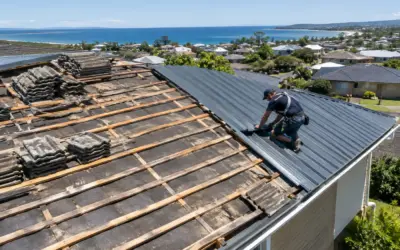
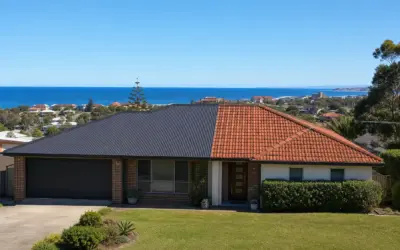
Repointing is a standard part of a full tile roof restoration, alongside cleaning, repairs and coating. That does not mean you need the whole package. If the tiles themselves are in good shape and the only real problem is the ridges, repointing on its own is a perfectly sensible job.
Doing more makes sense when the tiles are also faded, porous or covered in growth, because you pay for getting set up on the roof once instead of twice. If you are weighing that up, our breakdown of what goes into a roof restoration quote shows where repointing fits in the overall price.
Common questions about roof repointing
What is repointing on a roof?
Repointing is removing the old, cracked finishing layer of mortar along a tile roof’s ridges and hips and replacing it with a new flexible pointing compound. It seals the bedding underneath from the weather and helps keep the ridge caps secure.
How much does it cost to repoint a house roof?
It depends on the total length of ridges and hips, how many caps need rebedding rather than just pointing, the height and pitch of the roof and how easy it is to get onto. Rebedding adds noticeably more labour than pointing alone. We measure up and quote once we have inspected the roof and checked the caps.
Can you repoint a roof yourself?
The compound is sold at hardware stores, but we do not recommend it. The work is on the most exposed part of the roof, tiles crack easily underfoot and falls are a serious risk even on single storey homes. The real skill is judging which caps need rebedding, and pointing over failed bedding will not last.
How long does roof pointing last?
Flexible pointing laid over sound bedding lasts far longer than the old rigid cement pointing it replaces, because it moves with the roof instead of cracking. How long exactly depends on the product, the condition of the bedding and how exposed the roof is to wind, sun and salt.
What time of year is best for repointing?
Any time there is a run of dry weather. The compound needs to cure without being washed by rain, so we schedule around the forecast. The main thing is not to put it off until after the next big storm has found the gaps.
Do metal roofs need repointing?
No. Metal roofs use metal ridge capping that is screwed or fixed in place, so there is no mortar to fail. Their weak points are different, such as loose fixings, rust and flashings.
Get your ridges checked by a local roofer
Roofing Shellharbour is led by Ryan Bruce, who has more than 10 years of experience on tile and metal roofs. We will tell you plainly whether your ridges need repointing, rebedding or nothing at all yet, and what each option involves, without a sales pitch. Have a look at our roof repointing service in Shellharbour or call us on (02) 4215 8188.