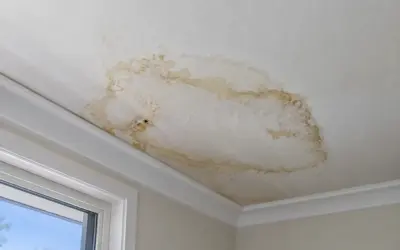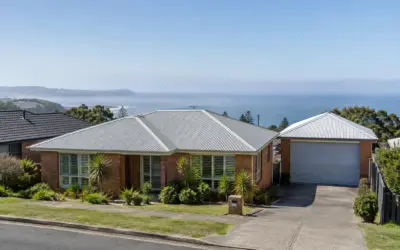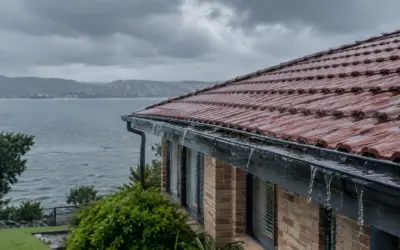
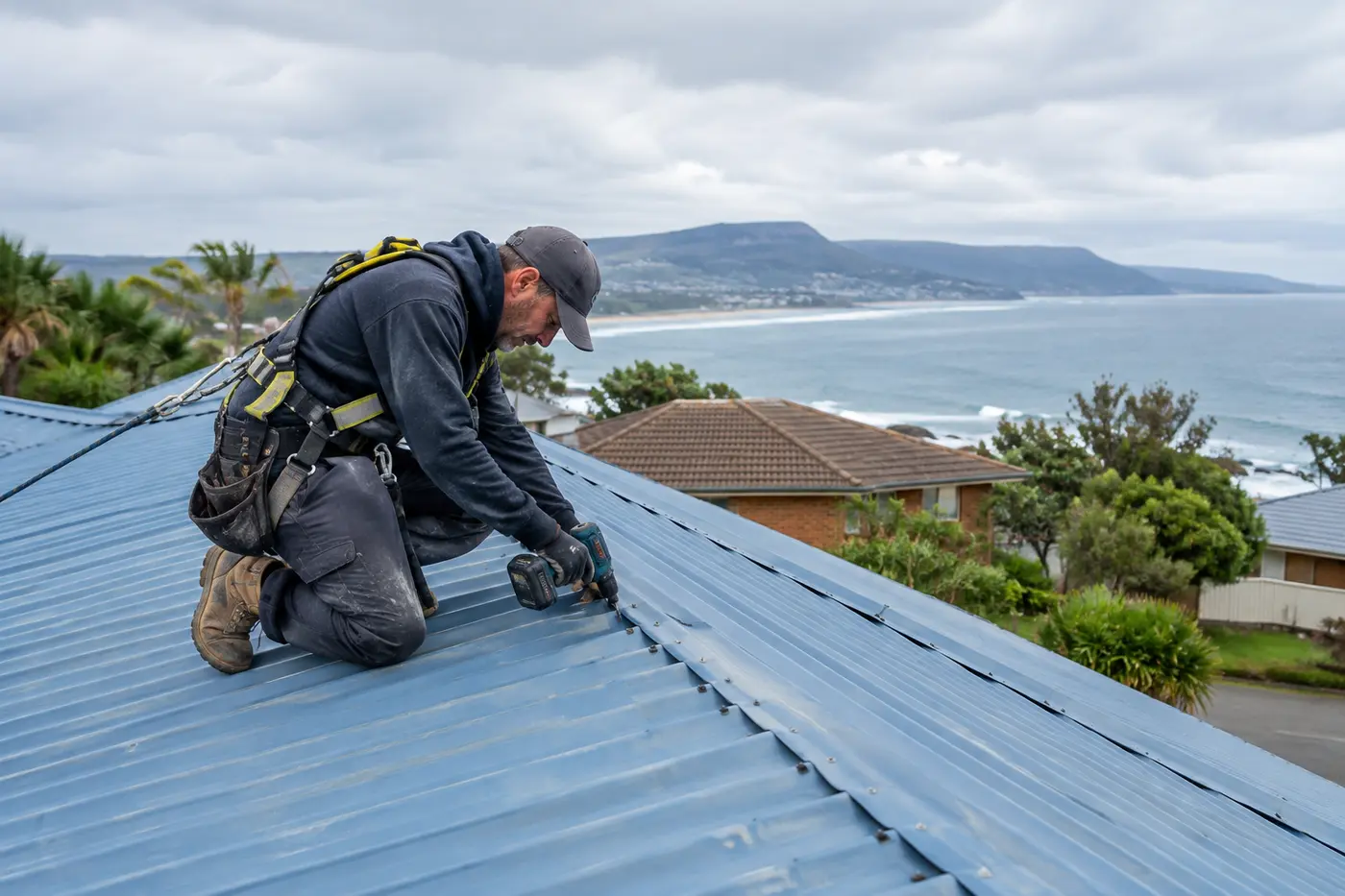
It is one of the most common calls we get after a storm. Water is dripping into the laundry, and the homeowner has already decided the whole Colorbond roof is finished and wants a price on a new one. Then we get up there and find a handful of screws with perished rubber washers, or a strip of old silicone that has lifted. That is a repair, not a new roof.
So, can a metal roof be repaired? Most of the time, yes. Metal roofs are built from separate sheets, screws, flashings and capping, and nearly every one of those parts can be replaced on its own. The real question is whether repairing makes sense for your roof, or whether you would be paying to patch something that is close to the end. That is what this guide is about.
Most metal roof faults are small parts failing, not the whole roof
When people picture a failing tin roof, they imagine rust everywhere. In practice, most of the leaks we trace on metal roofs around Shellharbour come from a short list of small items.
Screws and their washers
Every roofing screw has a rubber washer under its head that seals the hole. Years of sun dry that rubber out until it cracks, and the screw can also work loose as the sheets expand and contract through hot days and cool nights. Water then runs down the shank and into the ceiling. The fix is simple: pull the old screw and fit a new one with a fresh washer, sometimes one size up so it bites into solid metal.
Flashings and capping
Flashings are the folded metal pieces that seal joins, such as where the roof meets a wall, a chimney or a skylight. Ridge capping covers the peak. These are often where a leak starts, because they rely on sealant, careful folds and correct overlaps. A bent flashing, a dried out seal or a cap that has lifted in the wind can all be replaced without touching the main sheets.
Laps, ends and cut edges
Where one sheet overlaps the next, water and salt can get trapped and sit there. Over time this causes rust that starts underneath, where you cannot see it from the ground. The bottom ends of sheets over the gutter are another weak spot, as are any edges that were cut on site and never sealed.
Silicone patches from earlier repairs
This one surprises people. A lot of the leaks we find are on roofs that have already been “fixed” with a tube of silicone. Silicone smeared over a rust hole or a loose screw might stop the drip for a while, but it breaks down in the sun and can hold moisture against the metal, which speeds up the rust it was meant to cover.
What a proper metal roof repair actually involves
A good repair fixes the cause, not just the drip you can see. On a typical job we will work through some or all of these:
- replacing perished or loose screws across the affected run, not only the one above the stain
- swapping out individual sheets that have rusted through
- resealing or replacing flashings at walls, chimneys, vents and skylights
- refixing or replacing ridge capping that has lifted
- treating surface rust before it becomes a hole
- clearing metal filings left behind by earlier trades, which rust on the surface and stain the sheets
If you are not sure where the water is coming in, finding the entry point comes first. Water can travel a long way along a batten before it drips, so the stain in your ceiling is rarely directly under the fault. We explain how we track that down in our guide to finding a roof leak step by step.
Replacing a single sheet is very doable on most roofs. The catch on older roofs is matching. A new Colorbond sheet will be brighter than a faded one next to it, and older roofs may be an earlier profile or plain Zincalume. If you want to understand why those two materials age differently, our Zincalume and Colorbond comparison covers it.
When repair stops making sense
We work on what we call a decision-first approach. That means we tell you what we found and what the realistic options are, and you decide. Sometimes the honest answer is that repairs would be money spent on a roof that needs replacing. These are the signs that usually point that way.
Rust has gone through in lots of places. One or two rusted sheets can be swapped out. When a screwdriver goes through the metal on sheet after sheet, the roof is past patching.
The rust is coming from underneath. If the underside of the sheets is corroding (you might see flakes of rust in the roof space or on top of the insulation), the damage is usually wider than it looks from above.
The roof has been patched many times already. A roof covered in silicone, tar and odd offcuts is telling you something. Each new leak is likely to be followed by another.
You are chasing a new leak every season. If every heavy rain brings a drip somewhere new, the roof as a whole is wearing out.
Even then, it is not always all or nothing. On some homes we replace only the worst section, such as the side that cops the sea breeze, and repair the rest. That can put off a full reroof for a good while.
Salt air hits the sheltered parts of Shellharbour roofs hardest
Being close to the coast means salt settles on every roof in the area. Rain washes most of it off the open parts of the roof. The trouble spots are the sheltered areas the rain does not reach: under eaves overhangs, beneath upper storeys, behind parapets and around the back of solar panels. Salt sits there, draws in moisture and slowly eats the coating.
That is why we often see a roof in Shell Cove or Warilla that looks fine from the street but has heavy corrosion in one tucked away corner. It is also why hosing down those sheltered sections now and then does more good than most people expect.
Mixing metals is the other coastal trap. Copper pipes, lead flashings or stainless offcuts in contact with Zincalume or Colorbond can make the roof sheet corrode quickly, and moist salty air makes that reaction worse. Part of a good inspection is spotting those combinations and separating them.
Repair it properly or not at all
Ryan Bruce, who leads Roofing Shellharbour, has more than 10 years of experience on tile and metal roofs. The pattern over that time has been consistent: well done repairs on a sound roof last, while quick fixes on a tired roof come back. If your metal roof is leaking, rusting at the laps or showing loose screws, our metal roof repair service starts with a proper look at the cause, so you know whether you are dealing with a few parts or the whole roof. Call us on (02) 4215 8188 and we will tell you plainly which one it is.
Common questions about repairing a metal roof
How do I fix my metal roof?
Start by finding the cause, which is usually a failed screw washer, a lifted flashing or rust at a lap. The repair then matches the fault: new screws, a resealed or replaced flashing, or a new sheet. Metal roofs can be slippery and weak around rusted areas, so most homeowners are better off getting it inspected rather than climbing up themselves.
Does Flex Seal or silicone work on metal roofs?
As a stopgap, it can slow a drip until a roofer arrives. It is not a lasting repair. These products break down in strong sun and can trap water against the metal, so the rust underneath keeps going and the next repair becomes bigger.
What is the best patch for a metal roof?
For a hole that has rusted through, the most reliable fix is replacing the damaged sheet with new metal of the same profile. Light surface rust can be treated and painted. Stick on patches over active rust tend to fail because the corrosion carries on underneath.
Why does my metal roof leak during heavy rain?
Heavy rain shows up faults that light rain does not. Water backs up at laps, flashings and box gutters, or wind drives it sideways under capping and through loose screws. A leak that only appears in big storms often points to a flashing, an overflowing gutter or a lap that is too short.
How often do you replace a metal roof?
There is no set timetable. It depends on the coating, how close the home is to the sea, how much of the roof is sheltered from rain and how well it has been looked after. We judge it on condition: widespread rust through the sheets means replacement, while isolated problems can usually be repaired.
Can you replace just one sheet on a Colorbond roof?
Yes, in most cases. The new sheet needs to match the profile and sit under the correct laps, and on an older roof the colour will look brighter for a while. If several sheets on one side are failing, replacing that whole side is often the better result.