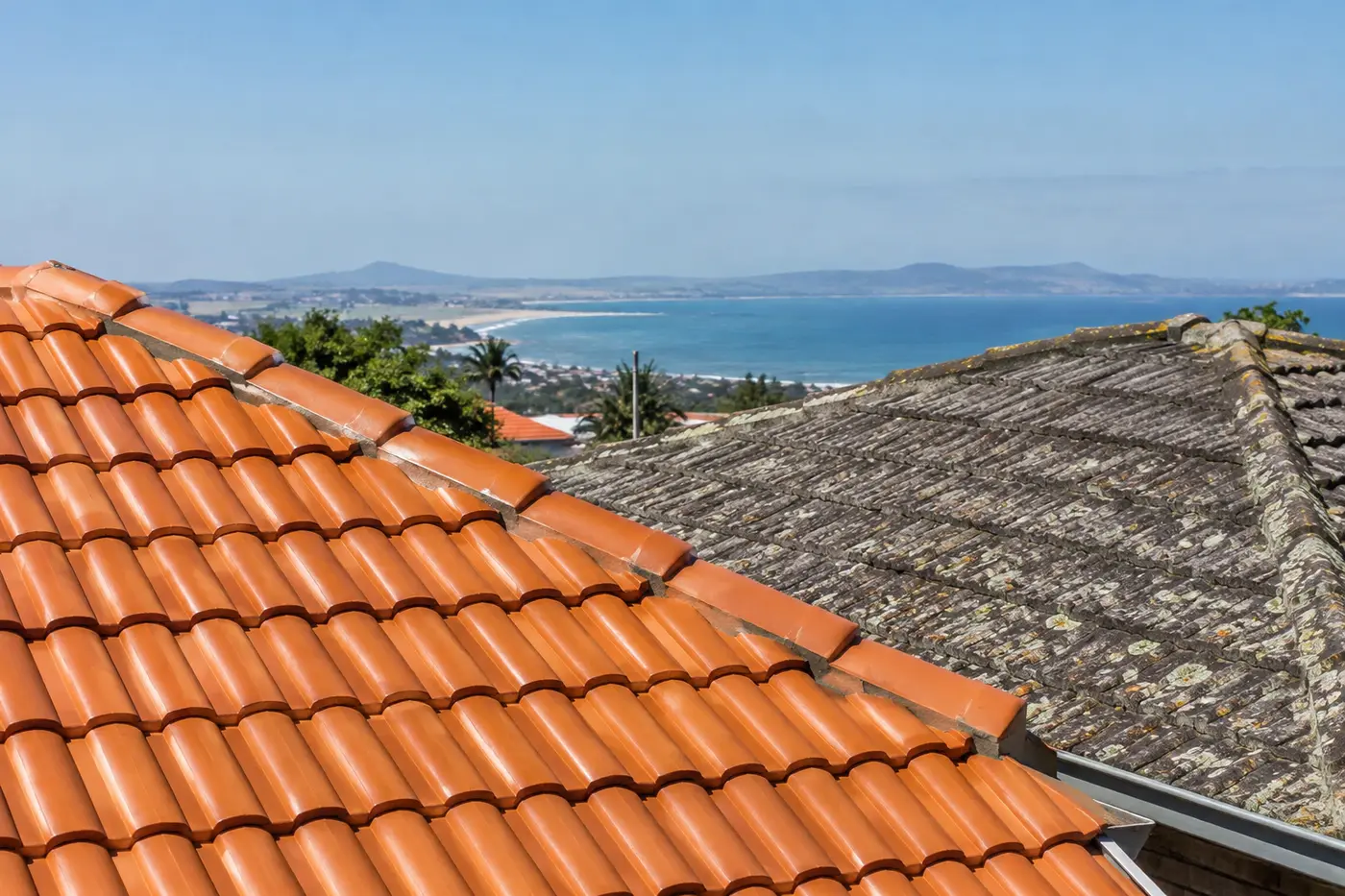
A Barrack Heights owner rang us recently with a simple question. Their neighbour had just had a concrete tile roof painted, the street was suddenly full of fresh charcoal roofs, and they wanted to know if their own faded orange tiles needed the same treatment. They didn’t. Their roof was terracotta, and that one detail changed the whole conversation.
Terracotta vs concrete roof tiles is a question we get two ways: from people choosing tiles for a new roof or extension, and from people who already own a tiled home and want to know what they’re dealing with. This guide covers both. The short version is that the two tiles look alike from the street but age very differently, and the right choice depends on budget, the house and how much upkeep you’re willing to do.
Same shape, very different material
Concrete tiles (you’ll also hear them called cement tiles; they’re the same thing) are made from cement, sand and water pressed into a mould. The colour comes from pigment mixed into the concrete and a coloured surface coat on top. That coat is what keeps the tile looking good and shedding water well.
Terracotta tiles are clay, shaped and then fired in a kiln. The heat turns the clay into a hard, dense ceramic. The colour is part of the material itself, either the natural clay colour or a glaze that is fused on during firing. Glazed terracotta is often sold as ceramic tile, which answers one of the most common questions we hear: terracotta is a ceramic, and the names overlap.
That difference in how the colour gets there explains almost everything else in this comparison.
Concrete weathers on the surface, terracotta mostly doesn’t
Most tiled roofs we look at around Shellharbour, Warilla and Oak Flats are concrete. They were the affordable default for decades of suburban building, and plenty are still doing their job. But the surface coat on a concrete tile wears away with sun, rain and salt air. Once it goes, the tile becomes more porous. It soaks up water, holds moisture longer, and gives lichen and moss a rough surface to grip. The colour fades to a chalky, patchy version of what it was.
That doesn’t mean a concrete tile is failing. A worn tile still sheds water in most cases. It just looks tired and gets dirtier faster, and that’s usually the point where owners start thinking about cleaning, sealing and recoating.
Terracotta ages more gracefully. Because the colour is baked in, it holds far better over time. Unglazed terracotta can weather and pick up some lichen too, but the tile body stays dense, and glazed tiles shrug off salt spray and grime better than anything else on a tiled roof. This is why the Barrack Heights roof didn’t need painting. Painting a sound terracotta roof is a cosmetic choice, not a repair, and once you paint it you’ve signed up to repaint it later.
Terracotta has real downsides too
We’d rather you hear these from us than find them later.
- Upfront cost. Terracotta costs more to buy than concrete, and the gap is noticeable on a full roof.
- Brittle underfoot. Fired clay is hard but can crack if someone walks on it carelessly. Antenna installers, solar crews and owners with a ladder are the usual culprits.
- Hard to match on older homes. The exact profile and colour may no longer be made, so repairs can mean sourcing second hand tiles.
Concrete has its own catch: it’s heavier than terracotta. On a new build the frame is designed for whatever tile is specified, so it rarely matters. It does matter if you’re thinking of switching materials on an existing roof, which we cover below.
The weak point is usually not the tile at all
This one surprises people. When a tiled roof in this area leaks, the tile itself is rarely the cause, whichever material it’s made from. The usual suspects are cracked or loose ridge capping, crumbling bedding and pointing (the mortar and flexible compound that hold the ridge caps in place), rusted valleys, and tiles knocked out of line.
Terracotta and concrete roofs use the same ridge and hip system, so they share the same weak spots. If your ridge lines look cracked or patchy, our guide to when a roof needs repointing explains what to look for. That job is the same on either tile.
So when someone asks us which tile lasts longer, our honest answer is that both usually outlast the parts holding them in place. The material you pick decides how much care the surface needs, not how soon the roof fails.
You can usually tell which tile you have from a broken edge
If you’re not sure what’s on your roof, you often don’t need to climb up. Look for a cracked tile in a garden bed, an offcut in the shed, or a spare left by a previous owner.
Concrete is grey inside, with the colour sitting as a skin on the surface. The underside feels rough and sandy, a bit like a footpath. Terracotta is the same colour all the way through a broken edge, usually an orange or reddish clay, and the underside is smoother. Tap two terracotta tiles together and they ring. Concrete gives a dull clunk.
From the ground, faded patchy colour with plenty of lichen usually points to concrete. A roof that still looks bright after many years, or has a glossy finish, is often glazed terracotta.
Switching from one tile to the other is a bigger job than it sounds
It can be done, but it isn’t a simple swap. The two tiles come in different sizes and profiles, so the battens they sit on usually need to be respaced or replaced. Going from concrete to terracotta takes weight off the frame, which is generally fine. Going from terracotta to concrete adds weight, and the frame has to be checked before that’s a safe decision.
In practice, most owners we talk to who want a change aren’t really choosing between two tiles. They’re weighing tile against metal. If that’s where your head is, our Colorbond and tile roof comparison is the better read.
Which one we’d point you towards
For an existing roof, the answer is almost always to keep what you have and maintain it properly. Re-roofing in a different tile is rarely worth it on its own.
For a new roof, an extension or a full tile replacement, it comes down to a few honest trade offs:
- Concrete if the budget is tight and you’re comfortable with cleaning and recoating down the track
- Terracotta if you plan to stay put, want colour that holds, and would rather pay more now than maintain more later
- Glazed terracotta if the house is close to the water and you want the surface that copes best with salt and grime
- Whatever is already on the house, for extensions where a mismatch would stand out from the street
Ryan Bruce has worked on tile and metal roofs for more than 10 years, and the advice he gives most often here is simple: choose for the next owner as well as yourself. The roof is one of the first things a buyer notices from the kerb.
If you’d like someone to look at your roof and tell you what it’s made of, what condition it’s in and what it actually needs, we handle terracotta and concrete tile roofing across the Shellharbour region. We’ll give you the facts and the options, and you make the call.
Common questions about terracotta and concrete tiles
Which is better, terracotta or concrete roof tiles?
Neither wins in every case. Terracotta holds its colour and needs less surface maintenance, but costs more upfront. Concrete is cheaper to buy and performs well, but its surface coat wears and it usually needs cleaning and recoating as it ages.
Are cement and concrete roof tiles the same?
Yes. Cement tile and concrete tile are two names for the same product, made from cement, sand and water. Suppliers and roofers use both terms.
What is the difference between terracotta and ceramic roof tiles?
Terracotta is a type of ceramic: clay that has been fired in a kiln. Tiles sold as ceramic are often glazed terracotta, where a glassy coating is fused to the surface during firing. The glaze widens the colour range and makes the tile even more resistant to staining.
How long does a terracotta tile roof last?
The tiles themselves are very long lived and are rarely the first thing to fail. On most older terracotta roofs we see, it’s the ridge bedding, pointing, valleys or flashings that need work, while the tiles can usually be cleaned and kept. Looking after those parts is what keeps the whole roof going.
What are the best roof tiles for a coastal area like Shellharbour?
Glazed terracotta handles salt air and grime best because the finish is fired on and doesn’t wear off. Concrete tiles are common near the coast and do the job, but expect the surface to weather faster and plan for maintenance. Either way, the fixings, valleys and ridge work matter as much as the tile.
Do terracotta tiles need painting?
Usually not. Because the colour is part of the tile, a sound terracotta roof generally just needs cleaning and any ridge or pointing repairs. Painting it is a style choice, and once painted it will need repainting down the track.