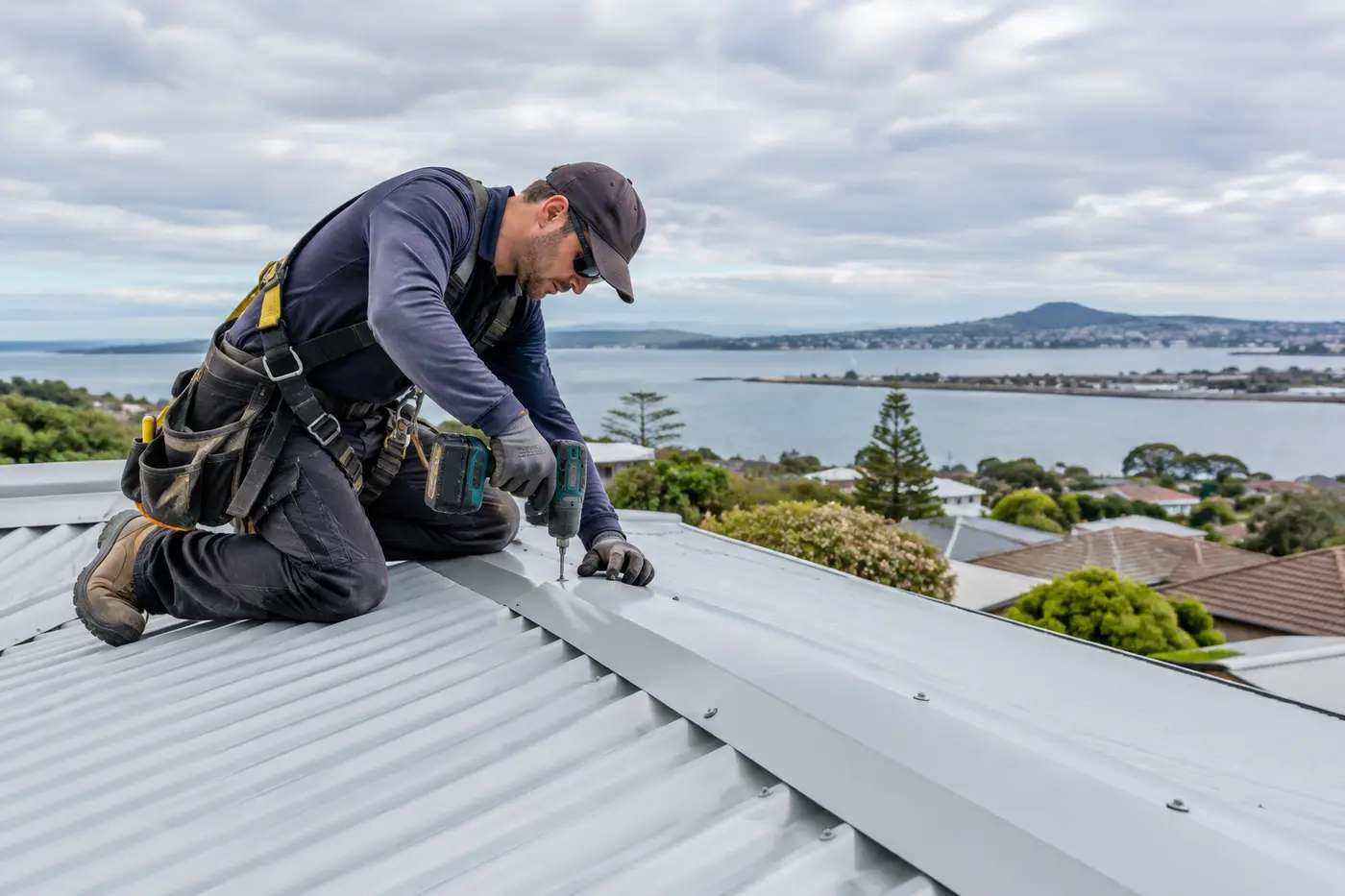
The call usually goes like this. It rained hard overnight, there’s a brown ring on the ceiling, and someone has already been up the ladder with a tube of silicone. The leak stopped for a while. Then it came back, sometimes a metre away from the first spot. Proper metal roof leak repair is less about the patch and more about finding the real entry point and fixing it in a way that suits steel, because a metal roof moves, sheds water fast and punishes shortcuts.
This guide walks through how we repair leaks on Colorbond and Zincalume roofs around Shellharbour, what each fix involves, and why some “repairs” just move the problem along.
The drip is rarely under the hole
Water that gets through a metal roof can travel a long way before it shows up. It runs down the underside of the sheet, along a batten or across the top of the sarking, then drops wherever it finds a low point. On a low pitch skillion it might run sideways. On a pitched roof it often tracks downhill toward the gutter line.
So the first step is always tracing, not sealing. We look at the stain, then go into the roof space if there is one, and only then get up top to check the sheets above and uphill of the wet patch. If you want to know more about that side of the job, our post on how we track down a roof leak covers the detection process in detail.
Five places metal roofs actually leak
Most of the metal roofs we look at leak from the same short list of spots. Each one has its own fix.
Roofing screws and their washers
Every screw is a hole in the roof, sealed by a rubber washer under the head. Over time the sun perishes that washer, it cracks or shrinks, and water gets in around the shank. Screws that were overdriven when the roof went on crush the washer flat from day one. Underdriven ones never seal properly. And screws that missed the batten underneath leave a loose screw rattling in a hole.
The fix is to replace the screws, not paint over them. We fit new screws with fresh washers, usually one gauge up if the old hole has worn oversized, and we pick up any that are rusted, loose or sitting crooked. On an older roof it’s often worth doing a whole run rather than just the one near the stain.
Laps between sheets
Where two sheets overlap side by side, water can be drawn up between them by capillary action, especially on lower pitches or where the lap has been laid the wrong way to the prevailing weather. End laps, where one sheet overlaps another down the slope, are worse on long runs. The repair depends on the cause: sometimes the lap needs extra fixing to pull it tight, sometimes the sheets need lifting and relaying.
Flashings and capping
Ridge capping, barge capping, apron flashings against walls and the flashing around a chimney all rely on being fixed and sealed correctly. We find flashings that were never turned down far enough, caps that have lifted in wind, and old lead or mismatched metal that has started corroding the steel next to it. Damaged sections usually need replacing with new flashing in a compatible metal, rather than being patched.
Penetrations
Anything that pokes through the roof is a weak point: flues, vent pipes, whirlybirds, skylights, aerial brackets and solar mounts. A rubber pipe flashing that has gone hard and split will let water straight in. A penetration in the wrong place, like across a sheet rib or right in a valley, will fight water every time it rains. Often the best repair is a new flashing designed for that roof profile, set and sealed properly.
Rust holes and corroded sheets
Rust usually starts where water or salt sits. That means the bottom ends of sheets at the gutter line, under overhangs that rain never washes clean, and anywhere metal filings (called swarf) were left on the roof after cutting. Small, isolated rust can sometimes be cut out and patched with matching sheet. Widespread rust through the sheet is a different conversation, and our post on when a metal roof is worth fixing versus replacing goes through how we make that call.
Why the silicone patch keeps failing
We are not against sealant. It has its place in a proper flashing joint, used with rivets and the right product for steel. What fails is sealant used on its own, as the whole repair.
Metal expands in the sun and contracts at night. A blob of silicone over a lap or a rusted screw has to stretch and shrink with it every day, and it eventually lets go at the edges. Worse, it can trap water underneath against the steel and speed up rust. It can also dam water so it backs up somewhere new, which is why the leak sometimes reappears a little way along.
Some sealants and repair products also aren’t compatible with Colorbond or Zincalume. Water running off certain metals, or off the wrong product, can corrode the coated steel below it. When we fix a leak we stick to materials that suit the roof.
What coastal air does to the job
Shellharbour roofs live with salt. Homes close to the water in Shell Cove, Barrack Heights and around Lake Illawarra see more salt build up on the roof, and the parts that rain doesn’t rinse are where it settles and works on screws and sheet edges. That changes how we repair. We check fixings well beyond the leak, look closely at the gutter ends of sheets, and match replacement screws and flashings to the roof’s material so the new parts don’t become the next weak spot.
What a proper repair looks like, start to finish
On a typical leak call, the order of work is fairly consistent:
- Look at the stain and the roof space to see where water is entering the ceiling.
- Get on the roof and inspect uphill and around the wet area, including screws, laps, flashings and penetrations.
- Find the actual entry point, and any others nearby that are close to failing.
- Repair the cause: new screws, refixed laps, replaced flashing, or new sheet.
- Clean off swarf and offcuts so they don’t rust on the roof.
- Explain what we found and what, if anything, needs watching.
That last step matters to us. Roofing Shellharbour is led by Ryan Bruce, who has more than 10 years of experience on tile and metal roofs, and we work on a decision-first approach: you get the facts about the current state of your roof and your options, not a sales pitch. If a leak can be fixed with a handful of screws, that’s what we’ll tell you. Our metal roof repair service covers residential roofs and larger commercial metal roofs alike.
What you can safely do before we arrive
Please don’t climb onto a wet metal roof. It’s slippery, and walking in the wrong spot can dent sheets and make the leak worse. Inside, put a bucket under the drip, move anything valuable, and if the ceiling is bulging with water, keep people out from under it. Take a photo of the stain and note when it leaks: during any rain, only in heavy rain, or only when the wind blows from a certain direction. That detail genuinely helps us find the cause faster.
Common questions about metal roof leaks
How do you fix a leak on a metal roof?
You find the real entry point first, then fix the cause. On most metal roofs that means replacing perished or loose screws, refixing or relaying a lap, replacing a damaged flashing or pipe boot, or cutting in new sheet where rust has gone through. A smear of sealant over the top is not a lasting repair.
What is the best patch for a metal roof?
For a small rust hole, the most durable patch is a piece of matching sheet, fixed and sealed with products that suit Colorbond or Zincalume. Tapes and paint on coatings can buy time, but they rarely last on a roof that heats up and cools down every day. If the rust is widespread, patching is usually throwing good money after bad.
Is it normal for a roof to leak in heavy rain?
No. A sound roof should stay dry in heavy rain. A leak that only appears in downpours often points to an overflowing gutter or valley, a lap that lets water creep in when there’s a lot of it, or a flashing that can’t cope with wind driven rain. It’s worth getting checked before the next big storm.
Is it expensive to fix a leaky metal roof?
It depends on what’s causing it. Replacing a run of screws is a very different job from replacing flashings or sheets, and access and roof height make a difference too. We’ve written a separate guide to what drives roof leak repair costs if you want the detail.
Who should I call to fix a leaking metal roof?
Call a roofer who works on metal roofs regularly. They will know the profile, the right screws and flashings, and which materials are safe to use together on coated steel. A handyman with a sealant gun can stop the drip for a week, but the cause usually stays.
Can I fix a leaking metal roof myself?
We’d advise against it. Working at height on steel sheeting is risky, especially when it’s wet, and a DIY sealant fix can trap water and hide the real problem. Taking photos and noting when it leaks is the most useful thing you can do.
If your Colorbond or Zincalume roof has started leaking, we can find where the water is getting in and fix the cause properly. Have a look at our metal roof repairs in Shellharbour and get in touch to book an inspection.