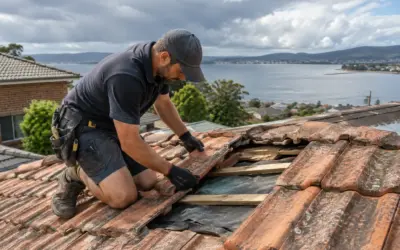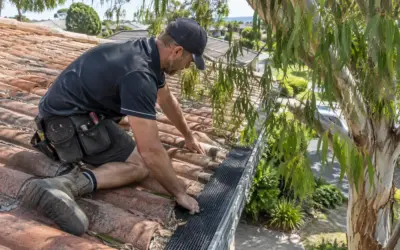
A homeowner in Warilla rang us last winter about a brown patch on the bedroom ceiling. The tiles looked fine from the street, and nothing was cracked or missing. Once we got up there, the story made sense. A strong southerly had pushed rain sideways under a couple of tiles, and with no roof sarking underneath, there was nothing to stop that water before it hit the plaster. On the house next door, built a few decades later, the same storm did nothing at all.
That difference is what sarking is about. It is one of those parts of a roof you never see, and most people only hear the word when a roofer quotes for it. So here is what it does, when it matters and when it honestly does not.
Sarking is the second line of defence under your roof
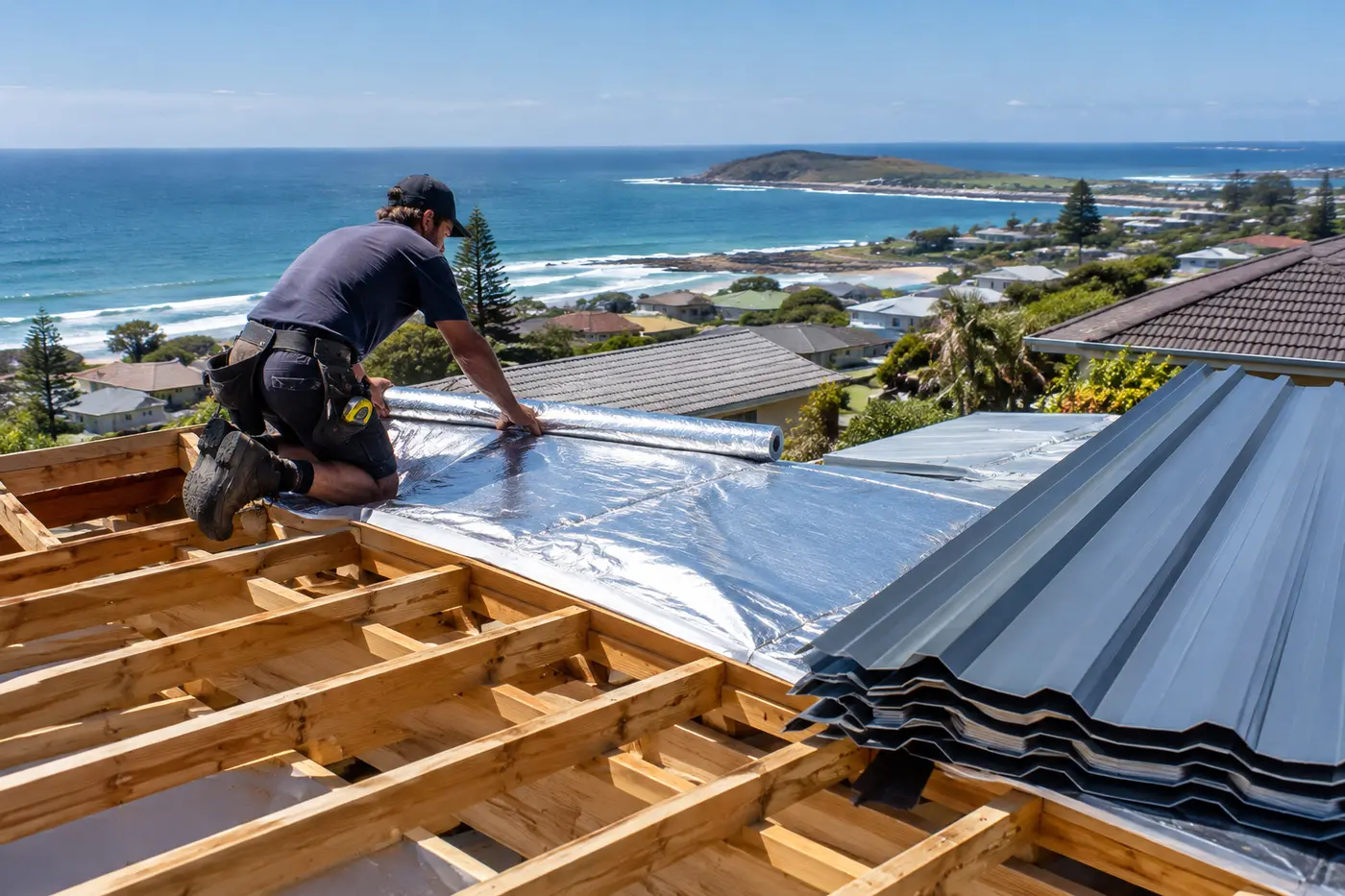
Sarking is a tough, flexible sheet laid across the rafters or trusses before the tiles or metal sheets go on. Most of what gets installed is foil laminate: a reinforced woven layer with a reflective foil face. Think of it as a raincoat worn under a jacket. The tiles or Colorbond do the main job of shedding water. The sarking catches whatever sneaks past and runs it down into the gutter instead of into your ceiling.
It does three useful things:
- Catches wind driven rain and dust that blow up under tiles or through laps
- Reflects radiant heat, so the roof space runs cooler in summer
- Deals with condensation forming on the underside of metal sheets
What it does not do is replace insulation. The foil helps with heat, but it is not a substitute for batts in the ceiling. People mix those two up a lot.
Tile roofs are not watertight, and sarking covers the gap
This one surprises people. A tile roof is not sealed. The tiles overlap and interlock, and in normal rain that is plenty. But tiles sit loose on battens, and a hard enough wind will drive rain up and over the laps. Add a cracked tile, a slipped one, or a valley packed with leaves, and water finds a way in.
Plenty of the older tile roofs we work on around Shellharbour, Warilla and Barrack Heights have no sarking at all. That was normal when they were built. On a sheltered block it might never cause a problem. On a ridge or close to the water, where the southerlies hit hardest, it is often the reason a leak only shows up in certain storms. If that sounds like your house, our guide to the usual reasons a roof starts leaking walks through the other suspects too.
Under Colorbond, the bigger job is condensation
Metal sheeting does not let wind driven rain through the way tiles can. The problem with metal is different. It cools quickly on a clear night, and moisture in the roof space condenses on the underside of the sheets. Without sarking, those drips land on the ceiling insulation or the plaster. Over time that means damp batts, stained ceilings and, in bad cases, rust starting from the inside of the sheet.
Living near the coast makes this worse, not better. Humid, salty air is exactly the kind that condenses. That is why we treat sarking as part of the job on metal roofs in this area, rather than an optional extra.
Adding sarking means the roof has to come off
People often ask if sarking can be added to an existing roof. Yes, but not by squeezing it in from the ceiling space. Sarking has to sit on top of the rafters, under the battens, so the roof covering has to come off for it to go in. That changes the maths a lot.
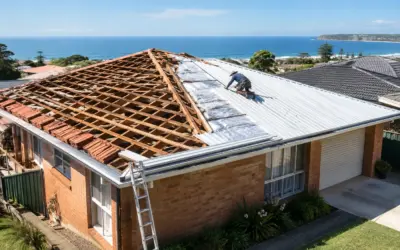
On a tile roof, it means lifting the tiles and battens, laying the sarking, fixing battens back down and relaying the tiles. On a metal roof, it means removing the sheets. For that reason we rarely recommend adding sarking as a job on its own. It makes sense when the roof is coming off anyway, such as during a re-roof or a switch from tiles to Colorbond. At that point the extra cost is small next to the roof itself, and it will never be easier to do.
If your roof is in good shape and you have one or two leaks, fixing the actual cause (a cracked tile, tired pointing, a rusted valley) is usually the better use of money. We would rather tell you that than sell you a roof you do not need.
Five situations where sarking earns its keep
- Any new metal roof, mainly for condensation control
- A tile roof being replaced or fully relaid
- Exposed blocks near the water or on high ground that cop the southerlies
- Homes in bushfire prone areas, where building rules can require it to keep embers out of the roof space
- Low pitched tile roofs, where water is more easily driven back under the tiles
Where it matters less: a sound tile roof on a sheltered block that has never leaked. There is no point pulling a good roof apart to add something it has managed without for decades.
Cheap sarking, badly laid, is barely better than none
Thin sarking tears during installation and sags between rafters, and a sag that holds water defeats the purpose. How it goes in matters as much as the product. The laps need to run the right way so water flows downhill over each join. The bottom edge has to drain into the gutter rather than behind the fascia. And it needs enough tension that it does not pond.
There is also a choice between standard foil sarking and vapour permeable types, which let moisture escape from the roof space while still stopping liquid water. Which one suits depends on the roof, the ceiling below it and how the space is ventilated. When we quote a full roof replacement, we spell out which sarking we plan to use and why, so you can compare quotes properly.
We look in the roof space before recommending anything
Ryan Bruce, who leads our team, has more than 10 years on tile and metal roofs, and the approach is the same on every job: look first, then give you the facts and the options without a sales pitch. For sarking, that means getting into the roof space where we can, checking whether there is an existing membrane and what state it is in, looking for water marks on the timbers, and working out whether a leak is really a sarking problem or something simpler.
Old sarking can perish, tear or come loose over time. Torn sarking hanging in the roof space is a common find on older homes. Sometimes it can be patched where it is reachable. Often it is simply a note for when the roof is eventually replaced.
Common questions about roof sarking
Is sarking mandatory in Australia?
Not on every roof. Whether it is required depends on things like the wind rating of the site, the roof pitch and whether the property is in a bushfire prone area. Even where it is not strictly required, most roofers treat it as standard practice on new metal roofs and replaced tile roofs.
Is roof sarking necessary?
On a new or replaced roof around Shellharbour, we would say yes in almost every case, because of the coastal wind and humidity. On an existing tile roof that has never leaked, it is not worth stripping the roof just to add it.
Do you need sarking under a Colorbond roof?
We strongly recommend it. The main reason is condensation, which forms under metal sheets on cool nights and drips onto insulation and ceilings. Sarking also cuts some of the heat coming through the roof.
Does sarking go under or over battens?
Under. It is laid across the rafters or trusses first, then the battens are fixed on top, and the tiles or sheets go on the battens. The gap between the sarking and the roof covering lets any water that gets in run down to the gutter.
Is it possible to have a roof without sarking?
Yes. Plenty of older homes in the area have none and get along fine. The risks are leaks in wind driven rain on tile roofs and condensation under metal roofs, so if you are not seeing either, it is not urgent.
How much does it cost to replace sarking on a roof?
The sarking itself is not the expensive part. Removing and refitting the tiles or sheets is what drives the price, which is why it is far better value to do it during a re-roof. We quote after seeing the roof, because size, pitch and access change the job a lot.
Planning a new roof? Ask about sarking first
If your roof is due for replacement, or you are chasing a leak that only appears in wild weather, we are happy to take a look and tell you plainly whether sarking is part of the answer. Read how we handle a roof replacement in Shellharbour, then get in touch to book an inspection.