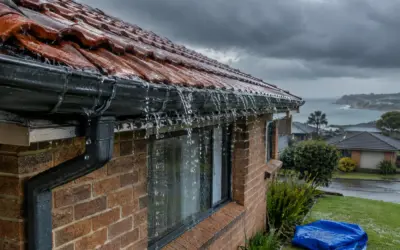
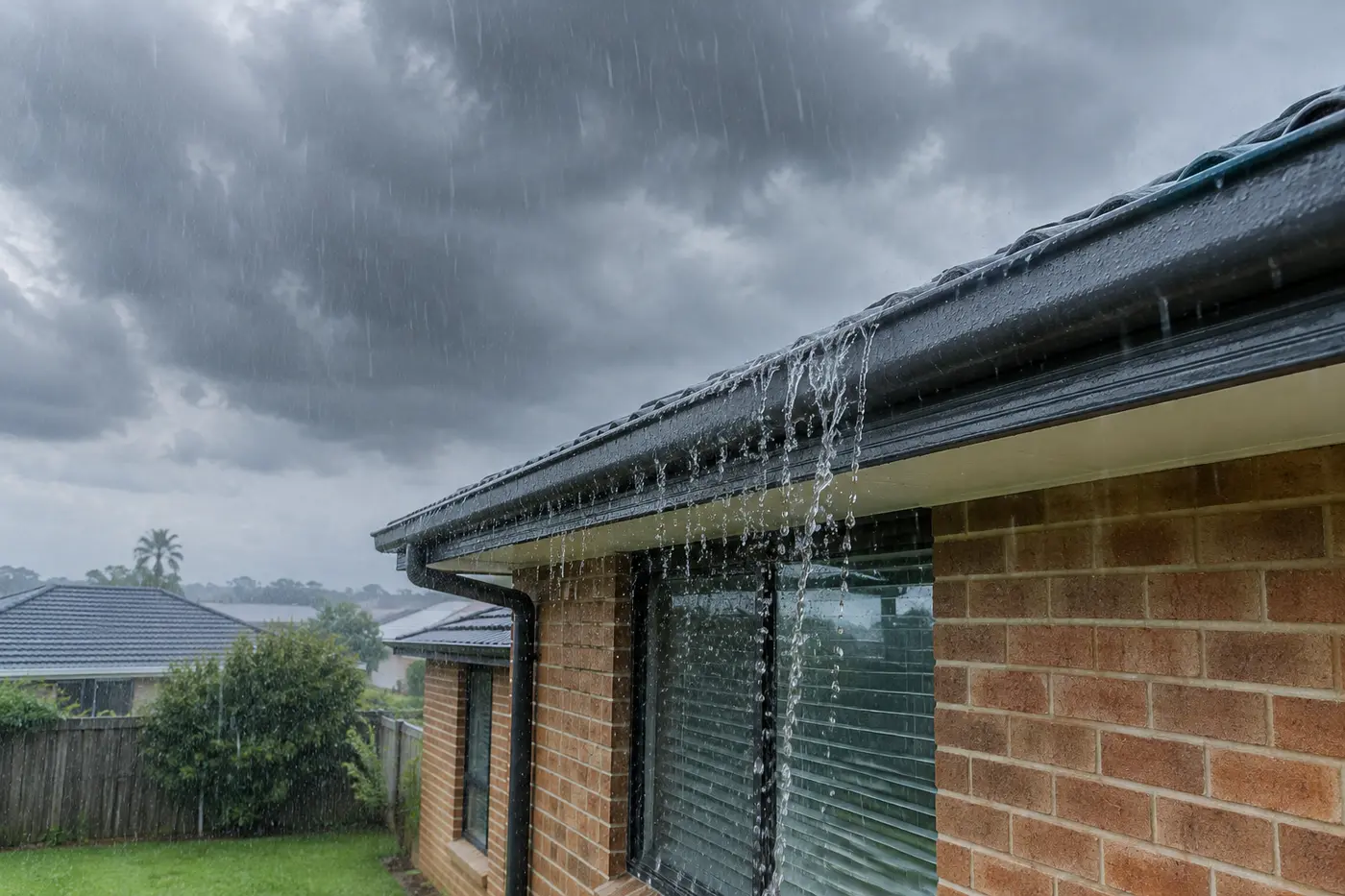
The rain is coming down hard, you look out the back window and there is a sheet of water pouring over the front of the gutter like a small waterfall. Overflowing gutters are one of the most common things we get called about after a summer storm around Shellharbour, and the cause is not always the one people expect. Clean gutters overflow too. Sometimes the gutter is just doing what it was built to do. Sometimes it is a warning that water is heading somewhere it shouldn’t.
Here is how we work out which one you have, and what actually fixes it.
A bit of overflow is not always a fault
Every gutter is sized for a certain amount of rain. During a short, very heavy burst, the kind that rolls off the escarpment on a hot afternoon, almost any gutter can spill for a minute or two. If it stops as soon as the downpour eases and the water falls clear of the house, that is usually nothing to lose sleep over.
What matters is where the water goes. Many newer gutters have slots along the front face so that, when they do overflow, water spills outward onto the garden. The problem cases are the ones that spill backward: behind the gutter, into the eaves, down the fascia board (the timber or metal board the gutter is fixed to) or into the wall. That is how a gutter problem turns into a stained ceiling or a damp internal wall.
So in the next storm, watch for one thing. Does the water come over the front edge, or does it show up behind the gutter, along the eaves lining or running down the brickwork?
Clean or not, these five things cause most overflows
Debris sitting right over the outlet
Leaves, gum nuts and twigs along the gutter are the obvious culprit. The less obvious one is the outlet, the hole where the gutter drains into the downpipe. A small clump of leaves over that outlet can stop it almost completely while the rest of the gutter looks clean from the ground. Homes near bushland in places like Blackbutt and Albion Park see this far more often than homes in newer estates with young gardens.
A blocked downpipe or stormwater line
If the gutter is clear and water still backs up, the blockage is probably lower down: the bend at the bottom of the downpipe, or the underground stormwater pipe it feeds into. Silt and tree roots build up in these over the years. A simple check on a dry day is to run a hose into the gutter near the outlet. If the water rises in the gutter instead of disappearing, the downpipe or the drain below it is the problem. Underground drains are a job for a plumber with a drain camera, and we will tell you straight if that is where it points.
Not enough downpipes for the roof
Each downpipe can only carry so much water. Extensions, second storeys and new patio roofs often add roof area without adding downpipes, so the original ones end up draining far more roof than they were ever planned for. We see this a lot on older homes that have grown over the decades. The fix is often an extra downpipe in the right spot, not a whole new gutter.
The gutter has lost its fall
Gutters need a slight slope, called the fall, running toward the outlet. Over time brackets loosen, fascia boards move and sections sag, so water pools in the low spots instead of running away. Standing water after rain, rust in one section, or a gutter that visibly dips between brackets are the giveaways. Close to the coast, that pooled water plus salt air is also what eats through older gutters fastest.
A valley dumping into one corner
Where two roof sections meet, the valley collects water from both and delivers it to a single point in the gutter. In heavy rain that much water arrives fast enough to shoot straight over the front or swamp the corner. A downpipe close to the valley, a splash guard at the corner, or a larger gutter on that run usually sorts it out.
Start with the cheapest fix that matches the cause
Most overflow problems do not need new gutters. Matching the fix to the cause is what keeps the bill sensible:
- Blocked outlet or gutter run: a proper clean, including clearing the outlet and flushing the downpipe
- Sagging sections: rebracketing and resetting the fall
- Too much water arriving at one point: an extra downpipe, or a splash guard at the valley corner
- Water spilling behind the gutter: correcting how the gutter sits on the fascia, or a slotted gutter that overflows to the front
- Rusted, split or undersized gutters: replacement, sized for the roof area each run drains
Replacement makes sense once a gutter is rusting through, leaking at the joints or is simply too small for the roof above it. Patching at that stage is money spent twice. New Colorbond gutters let us correct the size, the fall and the downpipe positions in one go. Our gutter replacement service starts by looking at how much roof each run actually drains, because a like-for-like swap just repeats the original problem.
Gutter guard helps, with one catch
Gutter guard stops leaves building up inside the gutter and over the outlets, so on a home surrounded by trees it can cut overflow a lot. What it cannot do is make a gutter bigger. If yours overflows because it is undersized or short on downpipes, guard will not change that. Mesh also needs the occasional brush off, since leaves sitting on top can slow water getting in during a downpour. We go through which homes benefit most in our guide to gutter guard pricing.
Box gutters overflow into the house, not the garden
If your home has a box gutter, the kind built into the roofline between two roof sections or behind a parapet wall, treat any overflow as urgent. There is no front edge for water to spill over. When a box gutter fills faster than it drains, the water goes into the roof space and ceilings instead. It usually shows up as a ceiling stain or a drip indoors rather than a waterfall outside. Our post on patching versus replacing a box gutter covers what we look for.
What to do during the storm, and once it clears
Stay off the ladder while it is raining. From the ground, note exactly where the water is spilling, and take a photo or short video if you can do it safely. Then check inside for drips or damp patches along exterior walls and ceilings near the eaves. Those photos make the cause much faster to find later, because a dry gutter on a sunny day rarely shows what it was doing at the peak of a storm.
Once it is dry, look along the gutters from the ground for sagging, rust and leaf build-up, and try the hose test on any downpipe you suspect.
If you would rather have someone look at it properly, Roofing Shellharbour is led by Ryan Bruce, who has more than 10 years of experience on tile and metal roofs. We will show you what is causing the overflow and the simplest way to fix it, with no sales pitch. If your gutters have reached the end of their life, ask us about new gutters sized for your roof.
Common questions about overflowing gutters
Why is water pouring out of my gutter when it looks clean?
The usual suspects are a blocked outlet or downpipe, a blocked stormwater pipe underground, too few downpipes for the roof area, or a valley sending a rush of water into one corner. A gutter that has sagged and lost its fall can also overflow at the low point even with no debris in it.
Is it normal for gutters to overflow in heavy rain?
A brief spill over the front during an extreme downpour can be normal. If it happens in every decent storm, carries on well after the rain eases, or the water comes out behind the gutter, something needs fixing.
How urgent is an overflowing gutter?
Water spilling clear of the house over the front edge is not an emergency, but it is worth sorting before the next run of storms. Water getting behind the gutter, into the eaves or out of a box gutter is more urgent, because it is getting into the building and can rot timber and stain ceilings.
Can gutter guard stop gutters overflowing?
Only when leaves and debris are the cause. Guard keeps outlets clear, but it does nothing for a gutter that is too small, short on downpipes or sagging.
Can you install larger gutters to handle heavy rain?
Yes. When we replace gutters we can step up the size and add downpipes where the roof needs them. The downpipes matter as much as the gutter, since a bigger gutter draining into the same single outlet will still back up.
Where should the water from my downpipes go?
Most homes have downpipes connected to an underground stormwater line. If a downpipe empties onto the ground beside the house, water can pool against the footings, so it is worth having a plumber connect it properly.