The call usually goes something like this. There is a brown ring on the bathroom ceiling, right next to the exhaust fan, or a drip landing on the kitchen bench under the range hood. The homeowner has had a plumber out, the pipes under the sink are dry, and nobody can work out where the water is coming from. Kitchen and bathroom roof leaks are some of the most common jobs we see around Shellharbour, and there is a simple reason they cluster in those two rooms.
Wet rooms are where the holes in your roof are.
Why wet rooms get more roof leaks than bedrooms
Every drain in a house needs a vent pipe that runs up through the roof so the plumbing can breathe. Those pipes sit above the bathroom, the laundry and the kitchen, because that is where the drains are. Add the bathroom exhaust fan, the range hood flue, and sometimes a skylight put in to brighten a windowless ensuite, and the roof above your wet rooms ends up with more penetrations than the rest of the house put together.
A penetration is any place where something passes through the roof covering. Each one has to be sealed with a flashing: a piece of rubber, metal or soft lead material that sheds water around the pipe instead of letting it in. The sheets or tiles themselves rarely fail in these spots. The seal around the pipe does.
First, rule out the shower
Before anyone climbs a ladder, it is worth answering one question. Does the ceiling get wet when it rains, or when someone showers?
If the stain grows on dry days, the roof is probably not the cause. The two likely culprits are a leaking pipe or fitting inside the ceiling, or an exhaust fan that vents into the roof space instead of outside. A fan that blows steamy air into the roof cavity lets that moisture settle on the underside of the roof and on the cold duct, and it drips straight back down around the fan grille. It looks exactly like a roof leak. It isn’t one.
If the drip only turns up during rain, and especially in heavy rain with wind from one direction, the roof is the prime suspect. We go through this rain test and a few others in our guide to telling a roof leak from a plumbing leak.
One safety point. If water is coming through a light fitting or the exhaust fan itself, switch that circuit off at the switchboard and keep it off until an electrician has checked it.
Five spots we check above a kitchen or bathroom
Most of the leaks we trace over wet rooms come down to one of these, listed roughly in the order we find them.
1. Vent pipe flashings on metal roofs
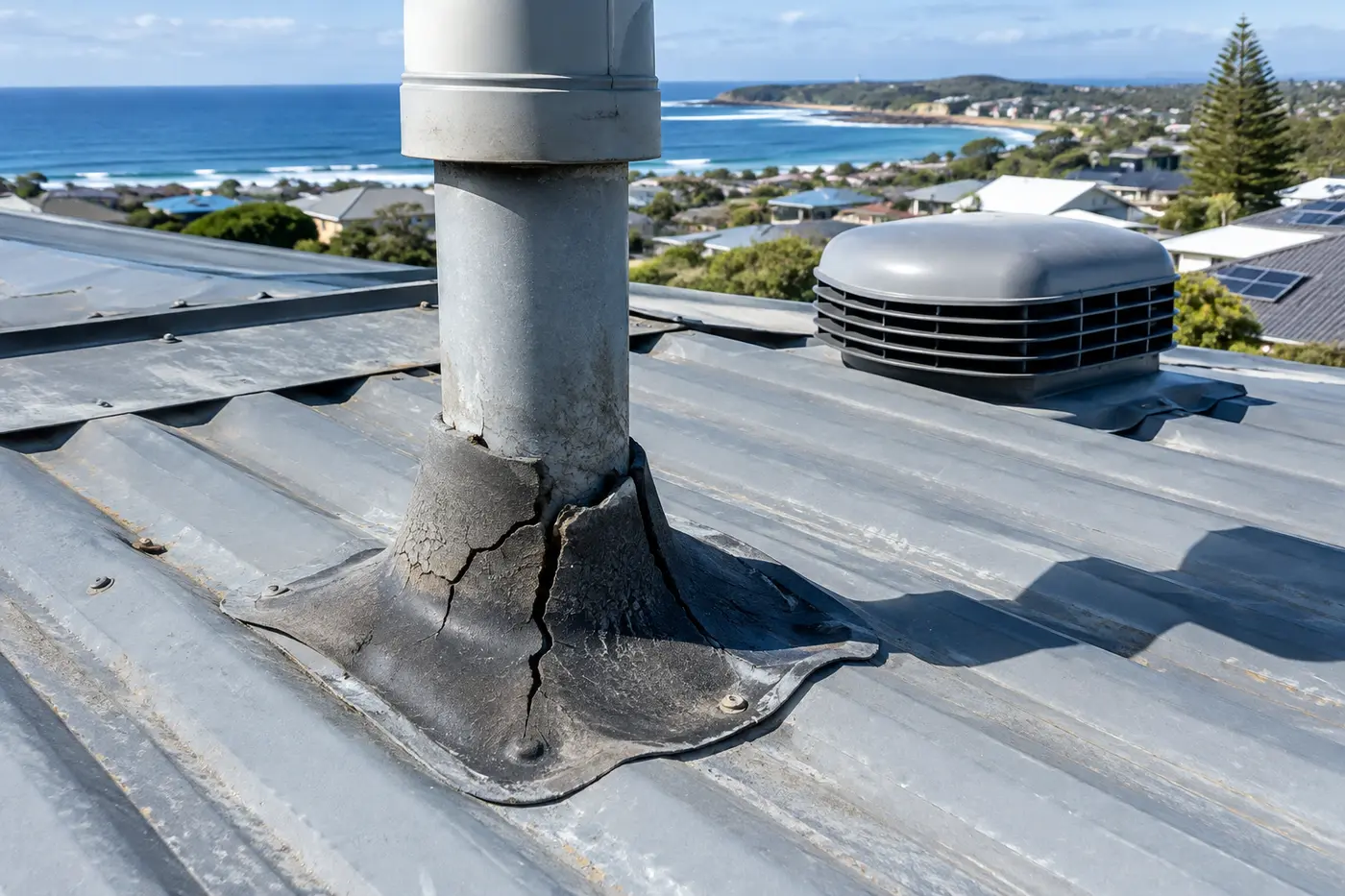
On a Colorbond or Zincalume roof, round pipes are usually sealed with a rubber or silicone boot flashing, often called by the brand name Dektite. The boot is screwed and sealed to the sheet. Sun and salt air break the rubber down over time until it cracks, splits or pulls away from the pipe. We also see boots that were fitted badly from day one: sitting across a rib so they never sealed flat, or placed so that water dams behind them on the uphill side.
2. Lead and soft flashings on tile roofs
On a tile roof, the pipe usually comes up through a cut tile with a soft flashing dressed over the tiles around it. These get lifted by wind, split along folds, or disturbed when someone walks on the roof to fix an antenna or clean the gutters. The tile around the pipe is often cracked too, because cutting a neat hole in a tile is fiddly work.
3. Exhaust fan cowls
A properly ducted bathroom fan ends in a cowl on the roof. That cowl has its own flashing, and it fails the same way a pipe flashing does. On older installs we sometimes find the duct has dropped off the fan below, which sends steam into the roof and causes the condensation problem described above.
4. Range hood flues
Kitchen flues pass through the roof with a cowl on top and a collar where they meet the roof. Heat ages the seals, and a cowl knocked crooked in a storm lets rain run down the outside of the flue and onto the ceiling.
5. Skylights
Skylights over showers and kitchens leak at the flashing kit around the frame, or where the uphill side catches leaves and holds water. Wide penetrations like these need water diverted around them properly. A skylight squeezed in without that detail will keep leaking no matter how much sealant goes on.
Silicone buys you weeks, not years
The most common thing we find on a leaking pipe flashing is a thick bead of silicone smeared over the crack by an earlier repair. It might stop the drip for a while. But silicone does not bond well to perished rubber or dirty lead, and once it lifts at one edge it can channel water in rather than keep it out.
The lasting fix is to replace the flashing. On a metal roof that means removing the old boot, cleaning the sheet, fitting a new boot sized to the pipe and the roof profile, then fixing it with the right screws and a compatible sealant. On a tile roof we replace any cracked tiles around the pipe and dress a new soft flashing over them so it sits tight to the tile shape. Cowls and flue collars get the same treatment. If a penetration was put in the wrong place to begin with, we tell you that too, rather than patching something that will fail again.
This work sits squarely within our flashing repair and replacement service, and once the source is confirmed it is usually a small, contained job.
Salt air wears these seals out faster near the water
Homes closer to the water, from Shell Cove up to Lake Illawarra and Albion Park Rail, put rubber seals and screw heads through far more salt than homes further inland. On a metal roof the pipe flashing is usually the first part to give up, well before the sheets themselves. If your roof has never had its penetrations looked at, they are worth checking even if nothing is dripping yet.
Sometimes the source is hard to pin down, because water can run along a rafter and show up a metre or two from where it got in. In those cases we trace it from inside the roof space as well as from outside. You can read how we go about finding a leak that hides before you book.
Common questions about kitchen and bathroom roof leaks
Why is my bathroom ceiling leaking when it is not raining?
Leaks on dry days are rarely the roof. The usual causes are a plumbing leak in the ceiling or wall, or an exhaust fan that vents steam into the roof space, where it condenses and drips back down. Check whether the fan is ducted outside before blaming the roof.
Can I fix a leaking roof vent pipe with silicone?
It can hold for a short time, but it is not a repair. Silicone does not stick well to aged rubber or lead and tends to lift at the edges. Replacing the pipe flashing is the fix that lasts.
Do I need a roofer or a plumber for a leaking vent pipe?
If water is getting in around the outside of the pipe where it passes through the roof, that is a flashing problem and a roofer is the right call. If the pipe itself is cracked, or a joint inside the ceiling is leaking, that is a job for a plumber. Often someone needs to look first to know which.
Why does my exhaust fan drip water?
Most of the time it is condensation. Warm, wet air from the shower cools in the duct or the roof space and runs back down to the fan. If it only happens when it rains, the cowl or its flashing on the roof is the more likely cause.
Is a leak near a light or exhaust fan dangerous?
It can be. Turn that circuit off at the switchboard and have an electrician check the fitting before you use it again. Then get the roof side sorted so it does not happen in the next storm.
If a stain is spreading across the bathroom ceiling or there is a drip near the range hood, we can check every penetration above it and tell you plainly what has failed and what it will take to fix. Have a look at our roof flashing repairs and get in touch to book a visit.