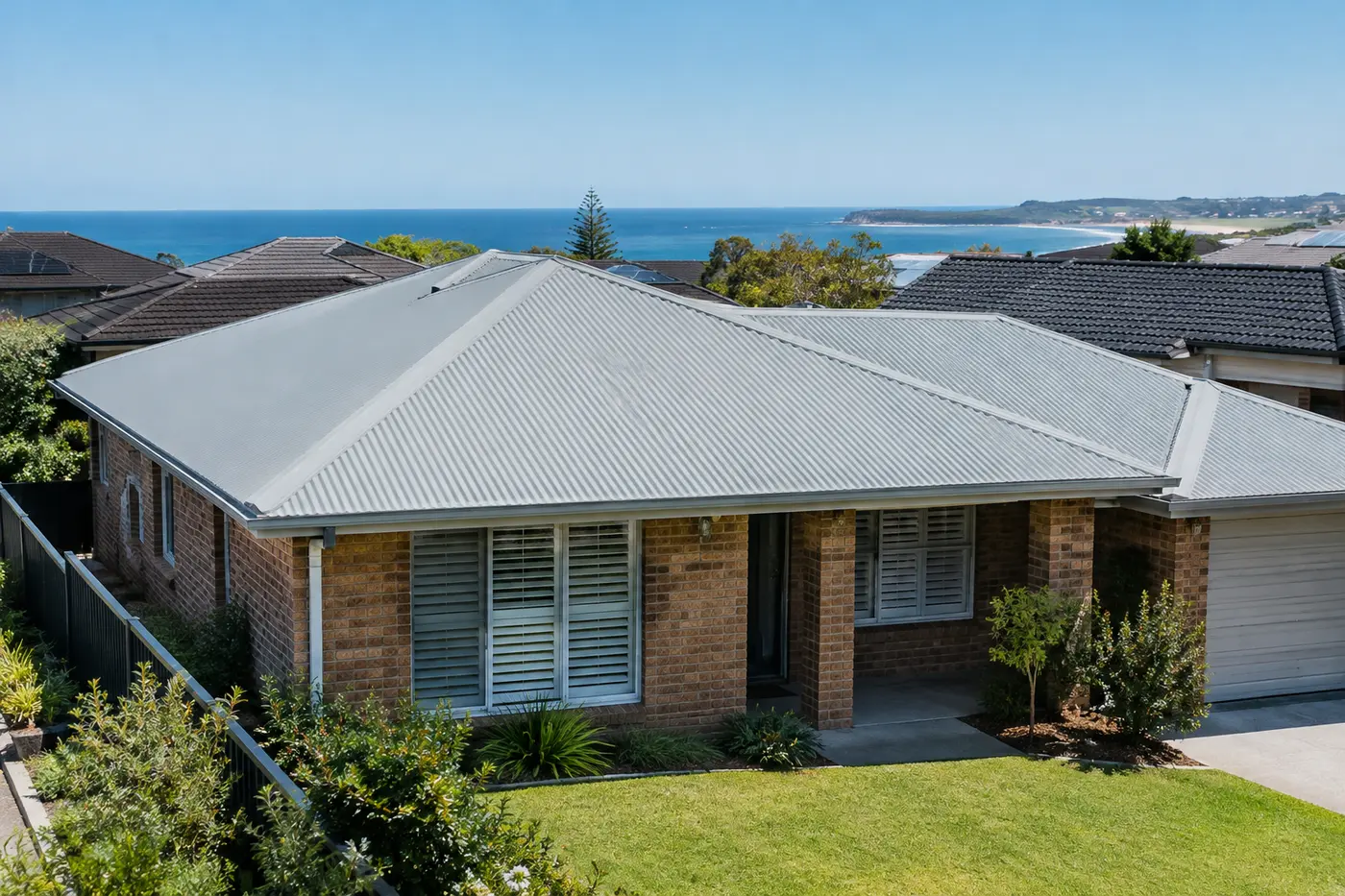
The sheets are ordered, the scaffold is booked, and the only thing holding up the job is a colour swatch stuck to the fridge. We see this a lot. Choosing between Colorbond roof colours feels like a style decision, and partly it is. But on a coastal home in Shellharbour, the colour you pick also changes how hot the house runs, how the roof looks after a few years of salt and sun, and whether the neighbours up the hill squint at it every afternoon.
Here is how we talk people through it, after more than 10 years working on tile and metal roofs around the region.
Colour changes how hot the house gets
This is the part most people underestimate. A dark roof absorbs more of the sun’s heat, and a light roof reflects more of it. Every current Colorbond colour has some heat reflecting technology built into the paint, so a dark Colorbond roof is not as hot as a dark roof from decades ago. The gap between light and dark is still real, though, and you feel it in the roof space and in the rooms under it on a still January afternoon.
Light colours such as Surfmist, Dover White, Shale Grey and Southerly sit at the cool end. Mid tones like Windspray, Bluegum and Jasper are in the middle. Monument, Night Sky and Ironstone are the warmest.
The sea breeze helps a lot of homes near the water, and good insulation under the sheets matters as much as the colour. If your ceiling space is already well insulated and the house gets afternoon shade, a darker roof is a smaller trade off. If you have a low pitched roof over living areas with little insulation, colour does more of the work.
One practical note for new builds and major renovations in NSW: your BASIX certificate can specify a roof colour category (light, medium or dark). Check it before you fall for a colour, because the certifier will.
Salt shows up differently on light and dark roofs
Every roof near the coast collects a fine film of salt. On a dark roof, that film and the dust that sticks to it can show as a greyish haze, especially on sections the rain doesn’t wash clean. On a light roof, salt is nearly invisible, but you are more likely to notice dirt streaks and the odd patch of mould in shaded spots.
Colour doesn’t change how well the steel resists corrosion. What protects the steel is the coating system underneath the paint and how often the roof gets rinsed. The parts that don’t get washed by rain, such as under eaves, the inside of gutters and areas sheltered by a second storey, are where salt sits longest and does the most damage. A hose down of those spots every few months is worth more than any colour choice.
If your home is close to the beach or gets direct salt spray, standard Colorbond may not be the right product at all. We cover where the line sits in our guide to Colorbond Ultra for homes near the surf. Ultra comes in a smaller selection of colours than the standard range, so confirm your choice is available before you set your heart on it.
Every colour fades a little, but some hide it better
All painted steel softens in colour over many years of UV exposure, and our coastal sun is strong. The difference is how noticeable it is. On a deep colour like Night Sky or Monument, a slight loss of depth can read as a chalky, washed out look. On Surfmist or Shale Grey, the same amount of change is hard to spot because the colour was pale to begin with.
This matters most if you ever need to patch the roof. A new sheet or flashing in a dark colour sitting next to a ten year old sheet can stand out. Lighter colours make repairs and additions blend in more easily.
Glare is a neighbour issue, and sometimes a council one
A very light roof on a sunny day is bright. If you are on flat ground, nobody much notices. If your home sits below other houses on a slope, the people above look straight down onto your roof, and a bright white surface catching the afternoon sun can be a genuine annoyance.
Some newer estates also have design guidelines that cover roof colours, either banning very reflective finishes or keeping a street within a palette. If you bought in a recent development, check your contract of sale or ask the developer before you order. It is a lot easier than changing sheets after the fact.
Light, mid or dark: how the trade offs stack up
Put side by side, the three groups look like this:
- Light (Surfmist, Dover White, Shale Grey, Southerly, Classic Cream): coolest, hides fading and salt, can cause glare, shows dirt streaks in shady spots.
- Mid tones (Windspray, Bluegum, Jasper, Dune, Basalt): a sensible middle on heat, forgiving of both dust and salt, suits most brick and rendered homes.
- Dark (Monument, Night Sky, Woodland Grey, Ironstone): strong modern look, warmest in summer, shows salt haze and fading more over time.
Mid greys are the colours we see chosen most often on Shellharbour homes, and there is a reason. They look good against the local mix of face brick, render and weatherboard, they don’t show much, and they keep the house reasonably cool.
Matching the roof to the house you already have
A roof colour has to live with things you are not changing: the brick, the window frames, the garage door, the fence and often the gutters. A few habits make the decision easier.
Look at a real sheet, outside, in daylight. A swatch on a phone screen or under kitchen lights tells you very little. Colours look lighter on a large roof than on a small sample, so if you are torn between two shades, the darker one on the swatch will often look about right once it is up.
Decide on the gutters, fascia and downpipes at the same time. Matching the roof is the safe option. A contrast, like a Monument gutter under a Shale Grey roof, can look sharp on a modern home but is harder to pull off on an older one.
Walk your street. The roof is the largest single surface on your house, and it reads as part of the streetscape. You don’t need to copy the neighbours, but a colour that looks great in a brochure can look out of place in a row of 1970s brick homes.
If you are moving from tiles to metal, the colour question is often the first real decision in the job. Our article on swapping a tiled roof for Colorbond covers the rest of what that change involves.
What we would actually pick on most Shellharbour homes
There is no single right answer, but we can give you a starting point. For a typical single storey home a few streets back from the water, a mid grey such as Windspray or Basalt, or a light grey such as Shale Grey, covers most bases: cool enough, forgiving of salt and dust, and easy to match with existing brick. If you want something darker for the look, go in knowing it will run warmer and will need a rinse more often to stay sharp. Very close to the beach, sort out the product first (standard or Ultra), then choose from the colours that product comes in.
When we quote a metal roof replacement in Shellharbour, we bring real samples and talk through how each option will sit on your particular house, including the gutters, flashings and trims. We would rather you take an extra week to decide than live with a colour you are not happy with for decades.
Common questions about Colorbond roof colours
Which colour metal roof fades the least?
All Colorbond colours are built for Australian sun, but lighter colours hide fading far better. A small change on Surfmist or Shale Grey is barely visible, while the same change on Night Sky or Monument can look chalky. If keeping a roof looking new for as long as possible is your priority, lean lighter.
What is the white Colorbond colour called?
The whitest colour in the range is Dover White. Surfmist is the more common choice, an off white with a slight warm undertone that is a little softer on the eye in bright coastal light.
What are the most popular Colorbond roof colours?
Around Shellharbour, we mostly see greys: Shale Grey, Windspray, Basalt, Woodland Grey and Monument. Surfmist is popular on coastal style and newer homes. Popular is a safe guide, but check the colour against your own brick and trims.
Is Shale Grey a good roof colour near the coast?
It is one of the easier choices. It sits at the cooler end, hides salt and fading well, and suits both older brick homes and modern builds. Its only real downside is that dirt streaks in shaded corners show more than on a mid grey.
How long does a Colorbond roof last?
That depends far more on how close you are to the surf, how the roof was installed and whether the unwashed areas get rinsed than on the colour. Near the ocean, make sure the product suits your exposure and the right fasteners and flashings are used. Colour mostly affects how the roof looks as it ages, not how long it lasts.
Can I paint straight over Colorbond?
Not straight over. A Colorbond roof needs cleaning and the right primer for the coating to bond, and the job only makes sense if the steel is still sound. If you are unhappy with a colour on a roof that is otherwise in good condition, painting is an option, but it is a bigger job than most people expect.