The call usually goes like this. It only leaks when the wind is from the south. The stain sits on the ceiling right next to a wall, or around the bathroom exhaust fan, and the roof itself looks fine from the yard. More often than not, we climb up and find the problem isn’t the tiles or the sheets at all. It’s the flashing. Roof flashing repair is one of the most common jobs we do around Shellharbour, and also one of the most commonly botched, so here is how we look at it.
Flashing is the joinery of your roof, and joins are where water gets in
Flashing is the formed strip of metal (or on older homes, lead) that covers any spot where the roof stops being one continuous surface. Roof sheets and tiles shed water well on their own. The trouble starts where they meet something else.
On a typical house that means a handful of places:
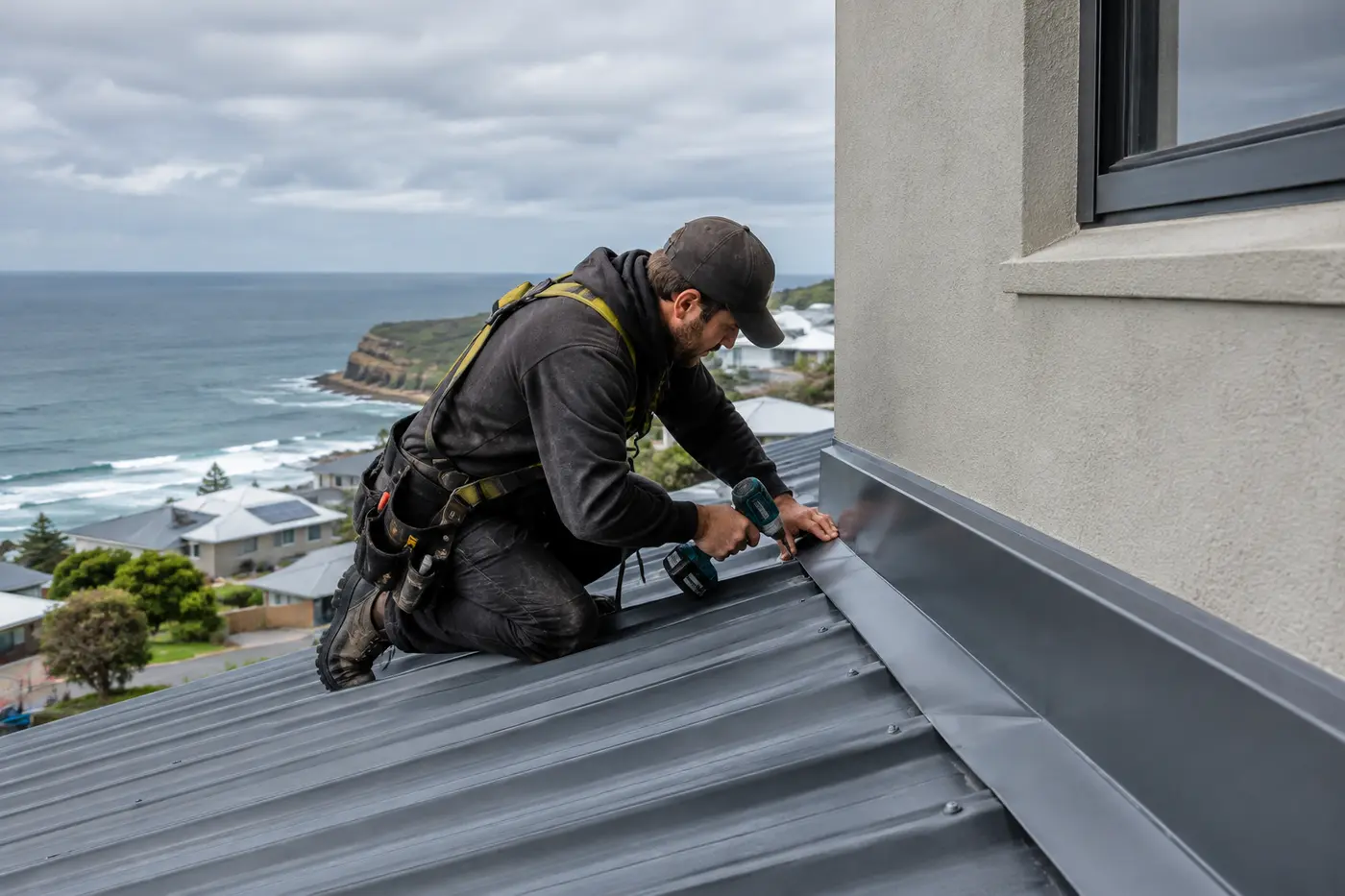
- Apron flashing, where a lower roof runs up to a wall, like a patio or extension against the house
- Side or step flashing, where a roof runs alongside a wall
- Chimney flashing, which wraps all four sides of the chimney
- Penetration flashing around vent pipes, exhaust fans, flues and skylights
- Barge and ridge flashings on metal roofs, covering the edges and the top
- Valley irons, the channels where two roof slopes meet
Valleys are a slightly different beast because they carry a lot of water rather than just sealing a join. We covered them separately in our guide to fixing or replacing valley iron. Everything else on that list is what this post is about.
Most flashing leaks start with one of five faults
After more than 10 years on tile and metal roofs in this area, the causes we find are remarkably consistent.
Silicone doing a job it was never meant to do
This is the big one. A flashing that was cut short, sits at the wrong angle or was never folded properly gets a thick bead of silicone run along it instead. It works for a while. Then the sun bakes it, the sealant shrinks and cracks, and water gets behind it. Sealant should be the backup on a flashing, not the thing holding the water out.
Mortar and pointing that has let go
On many older brick homes, the top edge of the flashing is tucked into a cut in the brickwork and held with mortar. Over the years that mortar cracks and falls out, the flashing lifts away from the wall, and rain runs straight down behind it. On tile roofs you see the same thing where the pointing along a wall junction has crumbled.
Wind lifting the edges
A flashing that isn’t fixed properly will lift a little in every strong wind. Each time it settles back slightly further out of place. Eventually there is a gap, and the next southerly drives rain sideways straight into it. This is why so many flashing leaks only show up in particular weather.
Salt and the wrong metals together
Homes closer to the water in Shell Cove, Barrack Heights and around Lake Illawarra get a steady coating of salt. Thin or cheap flashing corrodes first along cut edges and fixing points. We also see damage where metals that don’t get along have been used together, for example water running off copper onto a Zincalume or Colorbond roof, which eats into the coating over time.
Pipe boots that have perished
The rubber collars around vent pipes and flues break down in the sun. Once they split, water follows the pipe straight into the ceiling. It’s a small part, but it causes a lot of ceiling stains.
The signs show up inside before you see anything outside
You rarely spot failed flashing from the ground. What you notice is a water stain on the ceiling close to an external wall, a damp patch around an exhaust fan or downlight near a pipe, paint bubbling high on an internal wall, or a musty smell in one corner of a room. If the leak only appears in wind driven rain and not in steady rain, flashing moves right to the top of our suspect list.
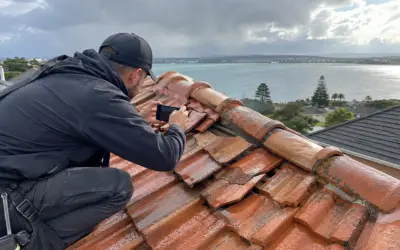
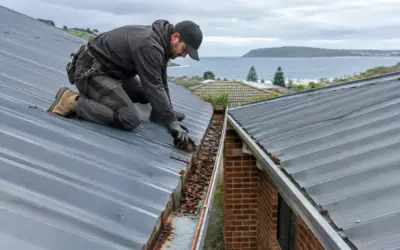
From up on the roof, we look for gaps between the flashing and the wall, cracked or missing sealant, rust along the edges, lifted fixings and pointing that has crumbled away. Sometimes it’s obvious. Sometimes we need a hose and a second person inside to prove it.
Some flashing can be repaired, and some needs replacing
Yes, flashing can often be repaired. The honest answer is that it depends on what failed.
A repair usually makes sense when the flashing itself is sound but the fixing or seal around it has failed. Refixing a lifted flashing with the right screws, raking out and repointing the mortar line, replacing a split pipe boot or cleaning back and resealing a joint are all legitimate fixes. They last when the metal underneath is still in good shape.
Replacement is the better call when the metal is rusted through, when it was the wrong size or shape to begin with, or when it has been patched so many times there is more silicone than steel. In those cases we fold a new flashing to suit the job. On metal roofs, that includes turning up the ends of the roof sheets under the flashing (called stop ends), which stops wind pushing water uphill and under the cover. It’s a small detail, and it’s missing from a surprising number of roofs we inspect.
Our flashing repair and replacement service covers both, and we will tell you plainly which one your roof needs.
Why tape and a tube of sealant rarely fix it for good
The hardware store aisle is full of flashing tape and sealants, and we understand the appeal. For an emergency, a patch can buy you time until someone can get up there properly. The problem is that tape and sealant treat the symptom, not the cause. If the flashing is too short, lifting in the wind or set at the wrong angle, the patch fails again, usually in the next big storm.
There is also the safety side. Flashings sit at the edges of roofs, against walls and around chimneys, which are exactly the places people slip. If you are not comfortable working at height, leave it.
What sets the cost of a flashing repair
No two flashing jobs cost the same, which is why we quote after seeing the roof rather than over the phone. The main things that move the price are the type of flashing and how much of it there is, whether it’s a repair or a full replacement, the roof material and pitch, how easy it is to get to, and whether there is water damage underneath that also needs attention.
Catching a flashing leak early is usually the cheapest outcome. Leave it, and water can rot battens, stain plaster and soak insulation, which turns a small roofing job into a bigger one. For a broader look at what drives pricing, our post on what a roof leak repair costs walks through it.
Get the flashing checked before the next southerly
If you have a stain near a wall, a leak around a pipe or a leak that only turns up in certain weather, it’s worth having someone look at the flashings before the next big storm makes it worse. Roofing Shellharbour is led by Ryan Bruce, and we work on tile and metal roofs for homes and commercial properties across the region. We will show you what we find, explain whether a repair will hold, and give you the options without a sales pitch. Start with our roof flashing repairs page to see what’s involved and get in touch.
Common questions about roof flashing repair
Can flashing be repaired, or does it always need replacing?
Flashing can often be repaired if the metal is still sound and only the fixings, pointing or seal have failed. If it has rusted through, was the wrong shape to begin with or has been patched over and over, replacement is the longer lasting fix. We decide once we have seen it up close.
How much do roof flashings cost?
It depends on the type of flashing, how much needs work, the roof material and access. A single pipe boot is a very different job to replacing the full apron flashing along a wall. We quote after inspecting, rather than guessing on the phone.
Do plumbers deal with roof leaks?
Some roof plumbers do flashing and metal roof work, but a general plumber who works on pipes and drains usually won’t. If the leak is coming from the roof itself, including flashings, a roofer is the right first call. If a water stain turns out to be from a pipe, we will tell you so.
Can I repair roof flashing against a wall myself?
You can apply sealant or flashing tape as a temporary patch, but it won’t fix a flashing that is lifting, too short or set at the wrong angle. Wall junctions are also some of the riskiest places to work on a roof. For a lasting result, the flashing needs to be refixed, repointed or replaced properly.
Is it cheaper to repair or replace a roof?
For a flashing leak, repair is almost always cheaper, because the problem is usually confined to one join. Replacing a whole roof only makes sense when the roof covering itself is failing across large areas. A leaking flashing on its own is not a reason to replace a roof.
Why does my roof only leak in wind driven rain?
That pattern points strongly to flashing. Steady rain runs down the roof as designed, but strong wind pushes water sideways and even uphill into small gaps at walls, chimneys and edges. Lifted flashing or missing stop ends on metal roofs are the usual culprits.