It usually starts with a brown ring on the ceiling, close to an internal corner of the house. Nothing showed up during the light showers. Then a proper southerly storm came through, and the next morning there was a drip. When we get up on the roof, the trouble is very often in the same spot: the valley. Roof valley repair is one of the most common jobs we do on older Shellharbour homes, and it is also one of the most misunderstood, so here is what is actually going on up there and how we decide between a patch and a full replacement.
A valley carries more water than any other part of the roof
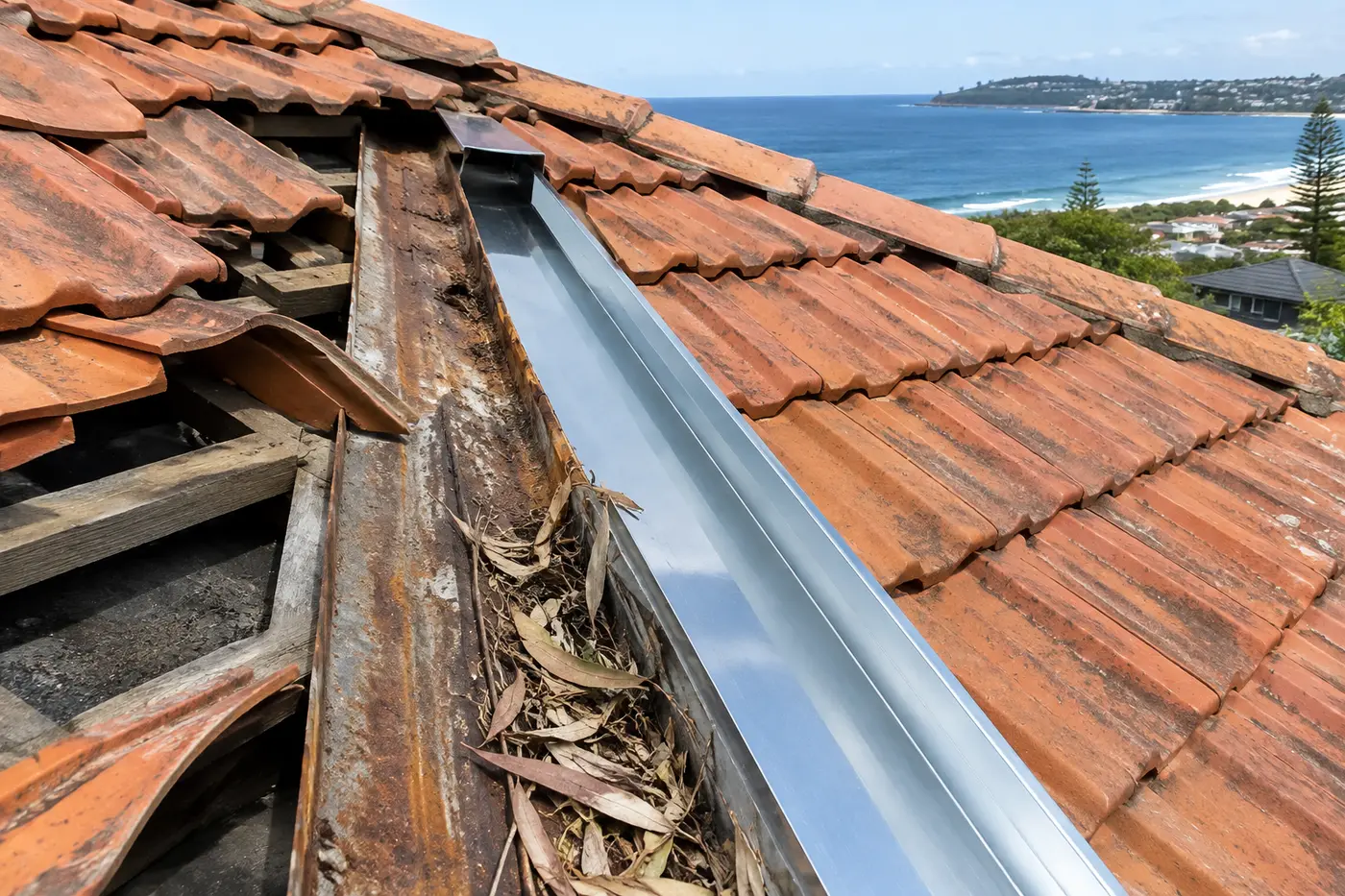
A valley is the channel that forms where two roof slopes meet at an inside angle. Picture an L shaped house: where the two wings join, the roof folds inward and creates a trough. On a tile roof, that trough is lined with a long strip of sheet metal called valley iron, and the tiles on each side are cut to sit over its edges. On a metal roof, the valley is a formed metal channel with the sheets lapping into it.
Every drop that lands on both of those slopes ends up funnelled into one narrow strip of metal. In steady rain that is fine. In a heavy downpour the valley is running like a small creek, and any weakness gets found fast. That is why valley leaks so often show up only in big storms and seem to vanish in between.
Why valleys fail on homes near the coast
Most of the failing valleys we see come down to a handful of causes, and on the coast they tend to stack on top of each other.
Rust working through from underneath
Salt air settles on everything in suburbs like Shell Cove, Barrack Heights and Warilla. Rain normally rinses an open roof sheet, but a valley holds moisture longer, especially where leaves and grit sit in it. Older valley iron rusts along the centre line and at the bottom end where water spills into the gutter. From above it can look like a bit of surface staining. Underneath, it is often pinholed.
Leaves and debris damming the channel
Gum leaves, seed pods and moss collect in valleys because that is where the water slows down. Once a dam forms, water backs up and spills sideways over the edge of the valley iron and under the tiles. The metal might be perfectly sound and the roof still leaks.
Tiles that have slipped or were cut too short
The tiles beside a valley are cut on an angle and held by mortar bedding. When that bedding cracks and lets go, tiles can slide into the channel and block it, or pull back and leave the edge of the valley iron open to wind driven rain. If the cut was made too short in the first place, the overlap was never enough. Loose bedding is closely related to the pointing problems we cover in our repointing guide, and we often fix both on the same visit.
Valleys that were too narrow from day one
Some older roofs simply have a valley that is too small for the area of roof feeding into it. It copes most of the year and overflows in the worst storms. No amount of sealant fixes a valley that is the wrong size.
Metals that do not get along
This one surprises people. Run off from lead flashing or copper onto Zincalume or Colorbond can speed up corrosion of the steel downstream. We sometimes find an otherwise healthy valley eaten away below an old lead flashing. The fix is to deal with the source, not just the valley.
Signs your valley is the problem
You do not need to climb up to spot most of these. A pair of binoculars from the footpath, or a look from a second storey window, will tell you plenty.
- A ceiling stain near an internal corner of the house, or below where two roof sections meet
- Water spilling over the gutter at the bottom of the valley during heavy rain
- Leaves or moss sitting in the valley line
- Orange or brown rust streaks at the lower end of the valley
- Tiles out of line beside the valley, or a gap showing bare metal edge
A stain on its own does not prove the valley is at fault. Water can run along a rafter before it drops, so the mark on the ceiling may be well away from the actual entry point. If you are not sure where it is coming from, our article on how we trace a roof leak to its source explains the process.
Repair or replace: how we make the call
We try to keep this decision simple and honest. A valley replacement is a bigger job than a clean and reseat, and you should only pay for it when the metal is actually finished.
A repair is usually enough when the valley iron is sound and the leak comes from debris, a slipped tile or loose bedding. Cleaning the channel, resetting the tiles and rebedding the cut edges can stop the leak completely. On a metal roof, a valley that leaks at a lap or a fixing can often be resealed and refixed.
Replacement makes more sense when the valley is rusted through, has already been patched with sealant several times, is too narrow for the roof feeding it, or is badly corroded at the bottom end. Sealant over rust buys a season at best. The rust keeps going underneath it, and you end up paying for the same callout twice.
A full valley replacement on a tile roof goes roughly like this. We lift the tiles on both sides of the valley, remove the old valley iron, and check the timber valley boards underneath for rot or sagging. New valley iron goes in, the tiles are cut and relaid with the right overlap, and the bedding and pointing along the valley edges is redone so the tiles stay put. On metal roofs, the old valley channel comes out and the sheet ends are turned and fixed properly into the new one. If you want more detail on how we handle it, our page on roof valley replacement in Shellharbour runs through the work.
What you can safely do in the meantime
If the valley is leaking right now, please do not get on the roof in the rain. Wet tiles and wet metal are both slippery, and tiles crack underfoot. Put a bucket under the drip, move anything valuable out of the way, and if the ceiling is sagging with water, keep people out of that room.
Once things dry out, clearing the gutter at the bottom of the valley from a ladder, if you are comfortable doing that, can stop water backing up. Beyond that, the valley itself is best left to someone who can lift tiles without breaking them and see what the metal looks like underneath.
Getting it looked at properly
Ryan Bruce has worked on tile and metal roofs across the Shellharbour region for more than 10 years, and the valleys are one of the first places we check on any leak call. We will tell you plainly whether a clean and reseat will do the job or whether the valley iron has reached the end of its life, and show you why. If you have a stain near an internal corner or water pouring over the gutter in storms, see how our valley repair and replacement service works and get in touch for a free quote.
Common questions about roof valley repair
How much does it cost to repair a roof valley?
It depends on what the valley needs. A clean, a few reset tiles and some rebedding is a much smaller job than lifting tiles and fitting new valley iron. The length of the valley, roof pitch, access and whether the timber underneath needs work all change the price, so we quote after seeing the roof.
How long do roof valleys last?
It varies with the material, how much debris the valley holds and how close the house is to the ocean. A valley that stays clean and dries out between storms lasts far longer than one that sits full of wet leaves. On coastal homes, the lower end of the valley is usually the first part to go.
Is it cheaper to repair or replace a roof valley?
A repair is cheaper on the day, and when the metal is sound it is the right choice. Once the valley iron is rusted through, repeated patching usually costs more over time than replacing it once. We will tell you which situation you are in.
How do you stop a leaking roof during heavy rain?
Stay off the roof until it is dry and safe. Catch the water inside with buckets or towels, move furniture and electronics away, and call a roofer once the weather clears. A temporary fix in the rain is risky and rarely holds.
Can I just put silicone in my roof valley?
Sealant can hold a small pinhole for a short while, but it does not stop rust spreading underneath, and a blob in the channel can catch debris and make damming worse. It is a stopgap, not a repair.
Do metal roofs have valleys too?
Yes. Any roof where two slopes meet at an inside angle has a valley, whatever it is covered with. On metal roofs the valley is a formed channel, and leaks usually come from laps, fixings or rust rather than slipped tiles.